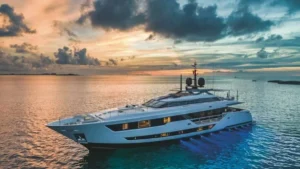
The best boats are the ones that match how you plan to use them, where you want to go and how much you want to spend. Some are built for fishing, others for family trips, watersports or overnight cruising. The right choice should fit your needs rather than simply have the biggest engine or the most features.
Recreational boats include fishing boats, pontoon boats, bowriders, wake boats and cruisers. Each has a different design and purpose. Some are easy to tow and store, while others need a marina.
This boat buying guide covers the best boats to consider in 2026, compares their features and explains what to check before you buy. It also covers prices, ownership costs, safety and the differences between new and used boats.
Key Takeaways
- Best family boat: Bayliner V22, with seating for up to 12 people.
- Best pontoon boat: Sun Tracker Party Barge 22 DLX, built for comfortable outings.
- Best fishing boat: Bayliner Trophy T22SC, with fishing features and space for 10.
- Best watersports boat: MasterCraft X24, with a dedicated wake and wave system.
- Best offshore fishing boat: Grady-White Express 340, with large fuel capacity.
- Best overnight cruiser: Cruisers Yachts 38 VTR EC, with an enclosed cockpit and cabin.
These picks are based on each model’s intended use, published specifications and features. Your own needs and local conditions still decide the best choice.
Best Boats to Buy in 2026
These models cover different types of boating and are not direct competitors, so compare them by intended use. A model name is not always its overall length, so check the published length.
1. Bayliner V22 – Best Family Boat

The Bayliner V22 is a bowrider designed for family outings and days out with friends. It measures 22 feet 5 inches, carries up to 12 people, supports up to 225 horsepower and holds 45 gallons of fuel.
The seating includes an L-shaped lounge, swivel bucket seats and a sunpad, while in-floor storage accommodates skis and wakeboards. An integrated cooler and stereo add to its appeal. Buyers comparing different boat sizes and styles may also want to explore this guide to 60-foot yachts for sale for larger vessels with more space and onboard amenities.
Advantages: spacious seating, useful storage and support for swimming and light watersports.
Limitations: It has no cabin, so it is less suitable for overnight trips.
2. Sun Tracker Party Barge 22 DLX – Best Pontoon Boat

The Sun Tracker Party Barge 22 DLX uses two aluminum pontoons to support a wide deck with plenty of seating and room to move. The 2026 model measures 24 feet 2 inches, has a recommended maximum of 150 horsepower and holds about 32.1 gallons of fuel. It adds a redesigned captain’s console, a touchscreen with integrated GPS, marine-grade flooring and an upgraded boarding ladder.
Advantages: wide deck, comfortable seating and easy boarding.
Limitations: Pontoons are less suited to rough water than deep-V boats, so check the engine setup before expecting strong towing or high speed.
3. Bayliner Trophy T22SC – Best Fishing Boat
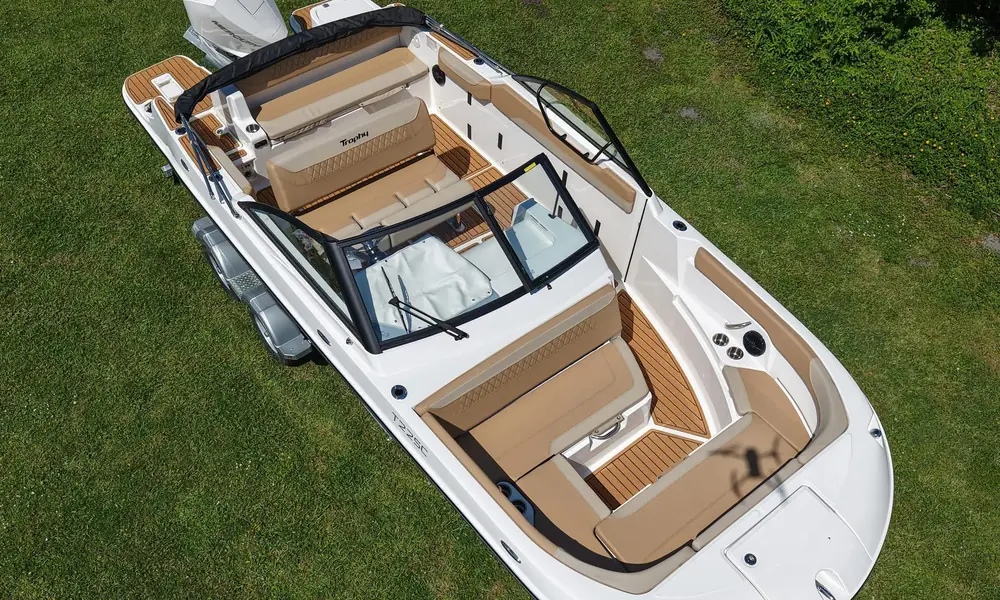
The Bayliner Trophy T22SC is a side-console fishing boat for anglers who also want family space. It measures 22 feet 7 inches with an 8 foot 6 inch beam, supports up to 250 horsepower, carries 10 people and holds 80 gallons of fuel. It has a self-bailing cockpit, a forward console bench, a swim platform, navigation lights and an automatic bilge pump.
Advantages: fishing-focused layout and room for gear and passengers.
Limitations: It has no cabin, so check range and weather limits before planning long offshore trips.
4. MasterCraft X24 – Best Watersports Boat

The MasterCraft X24 is built for wakesurfing and wakeboarding. It measures 24 feet 3 inches, seats up to 17 people, and has 4,050 pounds of ballast capacity and an 86-gallon fuel tank. Standard equipment includes the SurfStar system, FastFill ballast, an Ilmor MV8 6.2 GDI V-drive engine and a wakeboard tower.
Advantages: purpose-built wake systems and large seating capacity.
Limitations: A specialized wake boat can cost more to buy and maintain, and it is not ideal for fishing.
5. Grady-White Express 340 – Best Offshore Fishing Boat
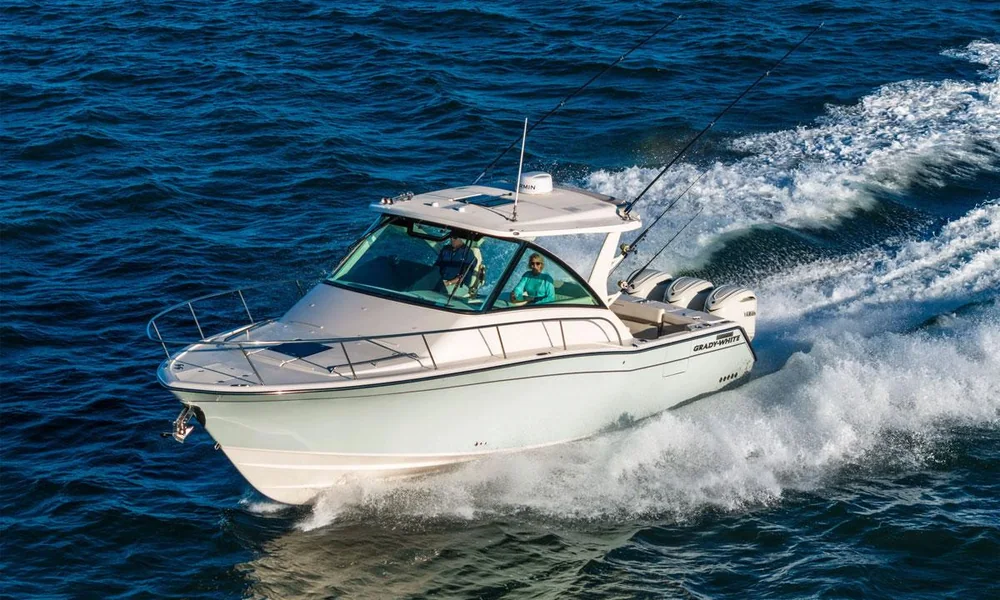
The Grady-White Express 340 combines offshore fishing gear with cabin comfort. Its centerline length is 33 feet 6 inches, its beam is 11 feet 7 inches and it holds 340 gallons of fuel, with up to 1,050 horsepower supported. Fishing features include insulated fish boxes, a 30-gallon livewell, rod holders and a hardtop.
Advantages: built for offshore trips, large fuel capacity and cabin facilities.
Limitations: Its size demands more storage, higher running costs and more experience.
6. Cruisers Yachts 38 VTR EC – Best Overnight Cruiser

The Cruisers Yachts 38 VTR EC is a sport cruiser for day trips and overnight stays. Its enclosed cockpit protects against changing weather, and its cabin includes a wet bar and a head with a sink and shower. It is 40 feet long with the outboards down (41 feet 11 inches raised), has an 11 foot 10 inch beam and holds 233 gallons of fuel. Options vary, so check the exact specification.
Advantages: enclosed cockpit, cabin facilities and comfortable entertaining space.
Limitations: It needs a larger budget and more storage than smaller boats.
Comparison of the Best Boats
| Boat model | Best for | Length | Fuel capacity |
|---|---|---|---|
| Bayliner V22 | Family outings | 22 ft 5 in | 45 gal |
| Sun Tracker Party Barge 22 DLX | Relaxed cruising | 24 ft 2 in | 32.1 gal |
| Bayliner Trophy T22SC | Fishing | 22 ft 7 in | 80 gal |
| MasterCraft X24 | Watersports | 24 ft 3 in | 86 gal |
| Grady-White Express 340 | Offshore fishing | 33 ft 6 in (centerline) | 340 gal |
| Cruisers Yachts 38 VTR EC | Overnight cruising | 40 ft (outboards down) | 233 gal |
Always confirm passenger capacity on the boat’s capacity plate or in the manufacturer’s documentation.
Types of Boats
Boat types differ in hull design, seating, engine setup and intended use.
- Fishing boats: Carry rod holders, fish boxes and livewells. Freshwater models differ from saltwater and offshore builds.
- Pontoon boats: Use flotation tubes under a wide deck, ideal for family outings and relaxing.
- Bowrider boats: Have open front seating for day cruising, swimming and light watersports.
- Center console boats: Place the helm mid-deck so anglers can walk around the boat.
- Deck boats: Have a wide bow for more passenger space than a typical bowrider.
- Wake and ski boats: Tow people, with wake boats using ballast to build bigger wakes and ski boats producing a flatter wake.
- Cabin cruisers: Offer sleeping areas, a small kitchen and a bathroom for longer stays.
- Sailboats: Use wind power, often with an auxiliary engine for maneuvering.
- Inflatable boats: Use air-filled tubes, with rigid inflatables adding a solid hull for better handling.
Best Boats for Different Needs
| Your main activity | Suitable boat type | Important features |
|---|---|---|
| Family outings | Pontoon or bowrider | Seating, shade, passenger capacity |
| Fishing | Center console or fishing boat | Rod holders, livewell, fish boxes |
| Watersports | Wake or ski boat | Engine, tower, ballast system |
| Overnight trips | Cabin cruiser | Sleeping space, bathroom, storage |
| Sailing | Sailboat | Sail plan, hull design, navigation |
| Short trips | Bowrider or deck boat | Easy handling and seating |
Best boats for beginners: A smaller bowrider, aluminum fishing boat or compact pontoon is easier to operate, tow and maintain than a large cruiser. Take a boating safety course whatever the size.
Best boats for lakes and rivers: Small fishing boats, compact bowriders and some pontoons work well. Consider water depth, current, local weather and launch access.
How to Choose the Right Boat

- Decide how you will use it. Start with your main activity. A boat built for one purpose usually performs better at it than an all-rounder.
- Choose the right size. Size affects space, handling, towing and cost. Check the manufacturer’s passenger and weight limits, and never assume a bigger boat is safe for more people.
- Consider the engine. Outboards are mounted outside the hull, inboards sit inside it, sterndrives combine both, and electric propulsion uses motors and batteries. Match the choice to your use and maintenance access.
- Check fuel efficiency. Consumption depends on engine size, weight, hull, speed and load, and a bigger engine is not always better. Ask for fuel data and compare boats under similar conditions.
- Consider materials. Fiberglass offers a smooth finish and flexible designs but repairs may need specialists. Aluminum is lightweight but can corrode. Inflatables are portable but need careful protection.
- Plan storage and transport. Decide where the boat will live. Check your vehicle’s towing capacity, trailer weight, launch access and local storage rules.
How Much Do Boats Cost?
Boat prices vary with size, brand, construction, engine, equipment and condition. A small recreational boat costs less than a large fishing boat or cruiser, and prices differ by dealer and region, so request a full written quote.
For example, Bayliner lists the V22 with a US starting price of around $56,094. That is a manufacturer’s starting price, not a final dealer price. Options, taxes, delivery and other charges raise it. Used boats may cost less, but condition and maintenance history matter greatly.
The purchase price is only the start. Budget for fuel, insurance, maintenance, storage or marina fees, registration, repairs, safety equipment and trailer or launching costs. The total depends on how often you use the boat, its size and engine, and local service prices.
New vs. Used Boats
| Factor | New boat | Used boat |
|---|---|---|
| Purchase price | Usually higher | Often lower |
| Condition | New from manufacturer | Depends on previous use |
| Warranty | Manufacturer warranty may apply | Depends on remaining coverage |
| Customization | More choices | Limited by existing setup |
| Maintenance history | Starts fresh | Needs careful review |
Buy new if you want the latest features, a specific configuration and warranty coverage. Buy used if you want to spend less or get a larger boat for your budget, but review maintenance records, engine condition, the hull and previous repairs. A professional marine survey can reveal problems a basic inspection misses.
What to Check Before Buying a Boat
- Hull: Look for cracks, unusual repairs, water intrusion and signs of accidents.
- Engine: Review service records and have a qualified technician inspect it.
- Electrical systems: Check batteries, lights, wiring and navigation equipment.
- Capacity: Confirm passenger and weight limits on the capacity plate.
- Sea trial: Test steering, controls, noise, vibration and handling on the water.
- Marine survey: For an older or expensive boat, an independent survey gives a detailed assessment.
Boat Safety Equipment
Required equipment depends on the boat’s size, design, location and local laws. Key items include:
- Life jackets: An approved, properly sized wearable jacket for every person onboard.
- Throwable flotation device: Under applicable US federal requirements, recreational boats 16 feet or longer must carry one.
- Navigation lights: They help other boaters see you in low light.
- Fire extinguishers: Carry those required for your boat’s configuration.
- Emergency communication: Choose equipment suited to where you operate.
- Bilge pump: It removes water that collects inside the boat.
Check the rules before every trip, review the weather, tell someone your plans and never exceed the rated capacity.
Frequently Asked Questions About the Best Boats
What is the best boat for everyday recreational use?
A bowrider or pontoon is a good choice. Bowriders suit cruising, swimming and some watersports, while pontoons offer more open seating for relaxing.
Which is better for a family: a pontoon or a bowrider?
A pontoon suits families who prioritize seating and deck space. A bowrider suits those who want a sportier boat. The better option depends on your activities.
Can one boat be used for both fishing and family outings?
Yes. Some dual-console and multipurpose fishing boats combine angling gear with passenger seating. Check that the layout leaves enough room for both.
What boat size is suitable for a first-time buyer?
There is no single ideal size, but a smaller boat is easier to tow, launch, store and operate. Consider capacity, local water and your experience.
Is a pontoon boat suitable for fishing?
Yes, especially on lakes and calm water. Some models include fishing chairs, rod holders and livewells, though they differ from specialized fishing boats.
How do I know if a boat will fit in my garage?
Check its storage length, width and height plus the trailer. Include the motor, hitch and any raised equipment, and confirm against manufacturer specifications.
Is a boat with a larger engine always better?
No. The right engine depends on the boat’s design, weight, use and recommended power range. A larger engine raises fuel use and operating costs.
What should I ask a boat dealer before buying?
Ask about the complete price, engine options, warranty, included equipment, delivery charges and service support. For a used boat, ask about service history, damage and ownership records.
Does a boat need a different engine for saltwater use?
Not necessarily. Many boats run in saltwater when equipped and maintained for it. Check the manufacturer’s guidance on corrosion protection.
What matters more when buying a boat: speed or stability?
Neither alone. Fishing, family cruising and watersports need different handling, so choose a design suited to your activities and conditions.
Conclusion
The best boats match your activities, budget and conditions. The Bayliner V22 suits family outings, the Sun Tracker Party Barge 22 DLX offers a spacious pontoon layout, the Bayliner Trophy T22SC and Grady-White Express 340 suit anglers, the MasterCraft X24 is built for watersports and the Cruisers Yachts 38 VTR EC suits overnight cruising.
Before buying, compare boat types, capacity, engines, maintenance needs and total ownership costs. Inspect the boat carefully and check its safety equipment, and you will find the right balance of comfort, performance and practicality.