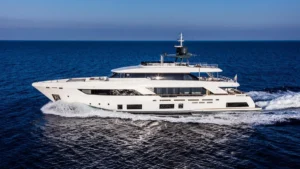
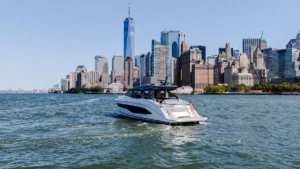
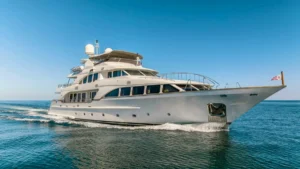
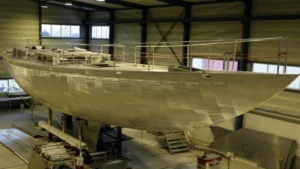
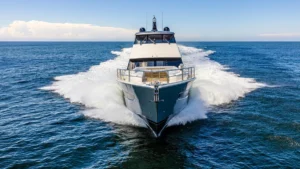
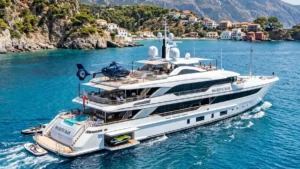
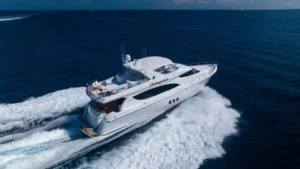
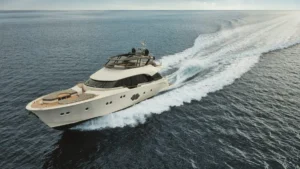
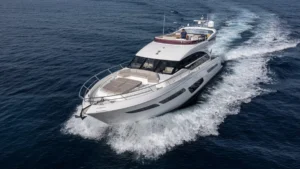
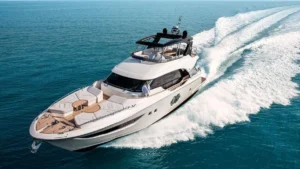
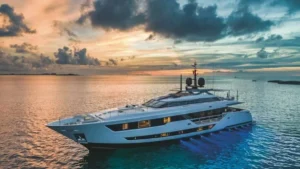
An 80 ft boat is a large vessel measuring approximately 24.38 metres. Boats in this size range include luxury motor yachts, flybridge yachts, sport yachts and sailing yachts. Layouts, engine power, passenger capacity and prices vary widely by manufacturer and model.
An 80-foot yacht can offer several guest cabins, spacious living areas, outdoor decks, modern navigation equipment and crew accommodation. But not every boat has the same facilities or performance. This guide covers dimensions, types, specifications, popular models, interiors, speed, range, prices, ownership costs and the key buying considerations.
What Is an 80 Ft Boat

An 80 ft boat has an advertised length of approximately 80 feet (24.38 metres). The term describes a rough size, not a specific design. Some 80-foot vessels focus on comfort and luxury, while others are built for performance, sailing or extended cruising.
An 80 ft yacht may include:
- Several guest cabins and bathrooms
- A main salon and dining area
- Indoor and outdoor seating
- A fully equipped galley
- Navigation and communication systems
- Crew accommodation on some models
- Outdoor spaces such as a flybridge or swimming platform
The actual facilities depend on the vessel’s design and equipment.
How Big Is an 80 Ft Boat?
An 80-foot boat is about 24.38 metres long, but its total size also depends on its beam, draft and height.
| Measurement | Meaning |
|---|---|
| Length overall (LOA) | Total reported length of the vessel |
| Waterline length | Length of the hull at the waterline |
| Beam | Maximum width of the boat |
| Draft | Depth of the boat below the waterline |
| Air draft | Height above the water, including relevant equipment |
Why Can the Actual Length Differ?
Some manufacturers include features such as a bow pulpit in overall length, while others publish figures with and without it. Check the builder’s measurement method instead of relying on the model name. The Sunseeker 80 Yacht, for example, has a published overall length of about 24.44 metres, while the Princess X80 measures about 25.11 metres.
Beam and draft matter just as much. A wider boat offers more interior space, while a deeper draft can limit access to shallow marinas and anchorages.
Types of 80 Ft Boats

Each type offers a different balance of speed, comfort and space.
Motor yacht. An 80 ft motor yacht uses engines for propulsion and is generally designed for comfortable cruising, with several guest cabins, indoor lounges and outdoor decks. Suitability for longer journeys depends on its range and equipment.
Flybridge yacht. A flybridge adds an upper deck, often with a second steering position, seating and entertainment space. It gives a good vantage point, but its height and layout affect bridge clearance and marina access.
Sport yacht. A sport yacht focuses on performance and a streamlined design, often with powerful engines, a lower profile and large outdoor areas. Speed, fuel use and comfort depend on hull design and engine configuration.
Sailing yacht. An 80 ft sailing yacht uses sails as its main propulsion, usually with an engine for maneuvering and calm conditions. It needs attention to sails, rigging and other sailing equipment, and its fuel use and range differ from a motor yacht’s.
80 Ft Boat Specifications
Specifications show a boat’s size, performance, capacity and operating needs, though figures vary between builders and models.
| Specification | What it tells you |
|---|---|
| Length overall | Total reported vessel length |
| Beam | Maximum width |
| Draft | Required water depth |
| Displacement | Vessel weight under a stated loading condition |
| Engine power | Available propulsion power |
| Fuel capacity | Maximum fuel tank capacity |
| Water capacity | Freshwater storage |
| Maximum speed | Highest stated speed under specified conditions |
| Cruising speed | Speed used for normal travel |
| Range | Estimated distance under stated conditions |
When comparing two boats, do not focus only on engine power. More powerful engines may give a higher top speed but also use more fuel. Fuel capacity, displacement, hull design and cruising speed all shape real performance.
Inside an 80 Ft Boat: Interior, Cabins, and Layout

The interior depends on the hull design, beam, number of decks and the owner’s requirements.
Main Living Areas
The main deck is usually the central living area. Depending on the model it may include:
- Main salon: an indoor space for relaxing and entertaining
- Dining area: often connected to the salon
- Galley: the onboard kitchen, with appliances, storage and refrigeration
- Helm station: where the captain controls and navigates the boat
Some designs put the galley on the main deck, while others use a different arrangement.
Guest Accommodation
The lower deck often holds the guest cabins. Larger 80-foot yachts may have a full-beam owner’s cabin, a forward VIP cabin and additional double or twin cabins. The number of bathrooms and berths varies by model.
Outdoor Living Areas
- Flybridge: an upper deck with seating, dining and sometimes a second helm
- Aft deck: an outdoor area near the stern for relaxing and dining
- Foredeck: the front of the boat, which may have sun loungers or seating
- Swimming platform: a rear platform giving access to the water
Crew Accommodation
Some 80 ft yachts include separate crew cabins and facilities, letting the crew work and rest without using guest areas. These may include sleeping quarters, a small bathroom and access to service areas.
Engine Performance, Speed, and Cruising Range

Engine power, hull design, displacement and fuel capacity all influence performance. Consider both speed and range rather than choosing on engine power alone.
Engine Options
Many large motor yachts use twin diesel engines, chosen for the vessel’s size, weight and performance goals. Some yachts prioritize speed, while others are designed for comfortable cruising and longer journeys. Sailing yachts differ because their sails provide the main driving force.
How Fast Can an 80 Ft Boat Go?
Maximum speed depends on the model, engine power, hull design and loading. The Princess Y80 has a published maximum speed range of 30 to 33 knots, depending on engines, while the Princess X80 lists 25 to 30 knots. Two yachts of similar size can therefore perform very differently. Maximum speed is also not normal cruising speed; owners often run below maximum depending on weather, fuel use and journey needs.
How Far Can an 80 Ft Boat Travel?
Cruising range is the distance a boat can travel under specific conditions before refuelling. It depends on:
- Fuel capacity: how much the tanks hold
- Fuel consumption: fuel used per hour or nautical mile
- Cruising speed: higher speeds often increase consumption
- Weather: wind, waves and currents
- Loading: passengers, supplies, equipment and fuel
A larger fuel tank does not automatically mean a longer range. Request the manufacturer’s range figures and confirm the conditions behind them. For longer journeys, plan fuel reserves and refuelling stops.
Features and Equipment Found on an 80 Ft Boat
Equipment depends on the design, intended use and specification.
Navigation and communication. Common systems include GPS and chartplotters, radar, depth sounders, electronic charts, marine radios and autopilot where fitted. Some systems are optional, so confirm what is installed before buying.
Safety equipment. Depending on the vessel and applicable rules, this may include life jackets and life-saving appliances, liferafts, fire detection and firefighting systems, bilge pumps and alarms, emergency communication equipment and navigation lights. Check that it suits the intended operation and complies with the rules.
Comfort and entertainment. An 80 ft luxury yacht may offer air conditioning, entertainment systems, lounge seating, modern kitchen appliances, generators, stabilizers and outdoor dining. Stabilizers can reduce rolling, though performance depends on the system and sea conditions.
Additional equipment. Some models add tender storage or garages, hydraulic swimming platforms, water toys, deck cranes, outdoor bars and extra refrigeration. None of these is standard on every boat, so check the individual specification and options list.
How Much Does an 80 Ft Boat Cost?
Price depends on the manufacturer, model, age, condition, equipment and market. New yachts with similar dimensions can have very different prices, and used boats may cost less, though condition and maintenance history can have a major effect on value. There is no single reliable price for every 80 ft boat. Compare current listings for the same or similar models, and check whether the advertised price includes taxes, delivery and other charges.
New vs. Used 80 Ft Boats
| Factor | New 80 ft boat | Used 80 ft boat |
|---|---|---|
| Purchase price | Usually higher | Can be lower |
| Condition | New construction | Depends on age and maintenance |
| Equipment | Selected factory specification | Existing equipment and upgrades |
| Customization | Options during construction | Changes may need extra work |
| Maintenance history | Begins with new ownership | Should be reviewed carefully |
| Availability | May require a build period | Existing boats may be available sooner |
What Affects the Price?
- Manufacturer and model: established builders and design categories have different pricing structures
- Age and condition: older yachts may need repairs, upgrades or equipment replacement
- Engine condition: engine hours and service records affect value
- Interior and equipment: custom interiors, navigation systems and generators raise the price
- Market location: taxes, duties, delivery and local demand vary between countries
How Much Does It Cost to Own an 80 Ft Boat?
The purchase is only the first expense. Owners also budget for fuel, maintenance, insurance, docking and other running costs.
- Fuel: depends on engine type, consumption, operating hours, cruising speed and local prices. A boat used for frequent high-speed trips will spend differently from one used mainly for slow cruising.
- Maintenance and repairs: engine and generator servicing, hull cleaning and inspection, antifouling, propulsion maintenance, electrical and plumbing repairs and replacing worn equipment. Age and condition make a big difference to this budget.
- Docking and marina fees: an 80 ft yacht needs a berth with enough length, width and depth. Electricity, water and waste services may cost extra.
- Insurance: depends on vessel value, age and condition, navigation area, intended use, the owner’s experience and the coverage. Compare policies carefully, because exclusions differ.
- Crew and management: some owners operate their boats themselves where legally and practically suitable, while others employ a professional captain and crew, with costs for salaries, training, travel and accommodation.
| Expense | What affects the cost |
|---|---|
| Fuel | Engine use, speed and fuel prices |
| Maintenance | Boat condition and servicing needs |
| Marina | Location, berth size and services |
| Insurance | Vessel value and coverage |
| Crew | Number of crew and employment terms |
| Repairs | Age, equipment and unexpected damage |
Prepare an individual operating budget rather than relying on a fixed percentage of the purchase price. Actual expenses vary considerably between boats and owners.
Best 80 Ft Boats and Yacht Models to Compare
Several builders offer yachts around 80 feet. The examples below come from manufacturer specifications, and some are slightly longer than 80 feet overall despite being marketed in the 80-foot category.
Princess Y80

The Princess Y80 is a flybridge motor yacht designed for comfortable cruising and outdoor living.
- Overall length: 25.50 metres (83 ft 8 in), including the pulpit
- Beam: 6.07 metres (19 ft 11 in)
- Draft: 1.80 metres (5 ft 10 in)
- Fuel capacity: 7,000 litres
- Guest accommodation: eight berths
- Engines: twin MAN V12 rated at 1,800 or 1,900 metric horsepower each
- Published maximum speed: 30 to 33 knots
It has four en-suite guest cabins plus crew accommodation, and its flybridge provides outdoor seating and dining.
Princess X80

The Princess X80 is a super flybridge design with a focus on interior space and outdoor living.
- Overall length: 25.11 metres (82 ft 5 in)
- Beam: 6.07 metres (19 ft 11 in)
- Draft: 1.83 metres (6 ft)
- Fuel capacity: 7,000 litres
- Guest accommodation: eight berths
- Engines: twin MAN V12 rated at 1,650 or 1,900 metric horsepower each
- Published maximum speed: 25 to 30 knots
It has four en-suite guest cabins, including a full-beam owner’s cabin.
Horizon FD80

The Horizon FD80 takes a different approach, with a focus on onboard volume and cruising capability. The FD80 Skyline specification lists:
- Overall length: 24.56 metres (80 ft 7 in)
- Waterline length: 21.58 metres (70 ft 9 in)
- Beam: 6.87 metres (22 ft 6 in)
- Draft at half load: 1.72 metres (5 ft 7 in)
- Fuel capacity: 10,220 litres; freshwater capacity: 1,500 litres
- Engines: twin MTU 10V2000M96L rated at 1,600 horsepower each
80 Ft Yacht Comparison Table
| Specification | Princess Y80 | Princess X80 | Horizon FD80 Skyline |
|---|---|---|---|
| Overall length | 25.50 m | 25.11 m | 24.56 m |
| Beam | 6.07 m | 6.07 m | 6.87 m |
| Draft | 1.80 m | 1.83 m | 1.72 m* |
| Fuel capacity | 7,000 L | 7,000 L | 10,220 L |
| Engines | Twin MAN V12 | Twin MAN V12 | Twin MTU |
| Guest berths | 8 | 8 | Depends on layout |
*Horizon draft is published at half load. Figures refer to stated specifications and may vary by version, market and installed options.
These models show there is no standard 80 ft specification. The Horizon FD80 has a wider beam and larger fuel capacity than the two Princess models.
What to Consider Before Buying an 80 Ft Boat

Buying one takes more planning than choosing by appearance or advertised price. Consider your intended use, budget, operating area and the boat’s technical condition.
Decide How You Will Use It
- Private cruising: comfortable cabins, outdoor seating and suitable facilities
- Coastal travel: draft, fuel range and access to suitable marinas
- Long-distance cruising: fuel capacity, range, storage, safety equipment and onboard systems
- Entertaining: the salon, dining areas, flybridge and guest accommodation
- Charter use: commercial registration, safety requirements and permitted passenger numbers
The best 80 ft boat is the one that matches your actual requirements.
Check the Boat’s Condition
Before buying a used boat, examine its maintenance history and physical condition: hull and deck, engines and propulsion, electrical and plumbing systems, fuel tanks and lines, navigation and communication equipment, generators, air conditioning and safety equipment. A clean appearance does not always mean the boat is mechanically sound.
Arrange an Independent Marine Survey
A professional survey can identify problems that a normal viewing misses. The process should include:
- Reviewing maintenance and service records
- Arranging an independent inspection
- Checking the hull, machinery and onboard systems
- Carrying out a sea trial where appropriate
- Reviewing the findings before completing the purchase
A survey does not guarantee that every future problem will be avoided, but it helps you decide with better information.
Check Registration and Legal Requirements
Registration and operating rules depend on the flag, location, intended use and passenger arrangements. Under UK rules, for example, large commercial yachts are generally defined by a load-line length of at least 24 metres together with conditions on commercial use, cargo and passenger numbers. That does not automatically apply to every privately owned 80 ft boat. Confirm the requirements with the relevant maritime authority or a qualified marine professional.
Confirm Marina Compatibility
Check overall length, beam, draft, air draft, available berth size and shore power requirements. A boat can fit the advertised length category and still be unsuitable for a marina because of its width or draft.
Advantages and Disadvantages of an 80 Ft Boat
| Advantages | Disadvantages |
|---|---|
| Spacious interior and outdoor areas | High purchase price |
| Multiple guest cabins on many models | Higher maintenance expenses |
| More onboard facilities | Higher fuel requirements on many motor yachts |
| Space for entertaining | May require professional crew |
| Suitable for extended cruising when properly equipped | Limited access to some marinas |
| More storage than many smaller boats | More complex onboard systems |
The actual pros and cons depend on the design, equipment and intended use.
Is an 80 Ft Boat Right for You?
An 80 ft boat suits buyers who want substantial onboard space, multiple guest cabins and facilities for comfortable cruising. But consider the full cost of ownership: fuel, maintenance, marina charges, insurance and crew can add considerably to the purchase price.
A smaller yacht may be more practical for occasional short trips or simpler maintenance. Compare specifications, space, range and operating requirements with your real needs before deciding.
Frequently Asked Questions About 80 Ft Boats
How many metres is an 80 ft boat?
About 24.38 metres. A yacht marketed in the 80-foot category may be longer overall because of its design and the builder’s measurement method.
Can an 80 ft boat fit in a standard marina berth?
Not necessarily. It needs a berth that can take its actual overall length, beam and draft, so confirm the marina’s available space before buying.
How many people can sleep on an 80 ft yacht?
It depends on the cabins and their arrangement. The Princess Y80 and X80 each list eight guest berths, with crew accommodation separate.
Can you live permanently on an 80 ft boat?
Some have the cabins, bathrooms, kitchens and freshwater storage to support extended stays. Permanent living also depends on storage, power, waste systems, marina access and local rules.
Does an 80 ft boat need a professional captain? I
t depends on the vessel, local laws, insurance conditions and the owner’s qualifications and experience. Some owners hire a captain for safe and practical operation.
Can an 80 ft boat cross the Atlantic?
Some may be suitable, but length alone does not establish ocean-crossing capability. Consider hull design, fuel range, seaworthiness, safety equipment, weather planning and crew experience.
Is a larger fuel tank always better?
No. Range also depends on fuel consumption, cruising speed, vessel weight and sea conditions, so compare verified range figures rather than tank size alone.
What is the difference between beam and draft?
Beam is the maximum width; draft is the depth below the waterline. Beam affects space and berth requirements, while draft affects access to shallow water and some marinas.
Should I buy an 80 ft yacht with more engine power?
Not automatically. More power can give higher speed but also affects fuel use and maintenance. The best configuration depends on your cruising style and the builder’s design.
What documents should I check before buying a used 80 ft boat?
Review ownership and registration documents, maintenance records, engine service history, survey reports, equipment records and any commercial certificates. A qualified marine professional can help verify the paperwork.
Conclusion
An 80 ft boat offers a combination of onboard space, accommodation and cruising capability, but models differ in dimensions, engines, fuel capacity and layout. Before buying, compare actual specifications, guest accommodation, performance and running costs. Check the condition through an independent marine survey and confirm that the boat meets the requirements of your intended cruising area.
The right boat is not necessarily the fastest or the largest. It is the one whose space, performance and facilities match your needs and budget.