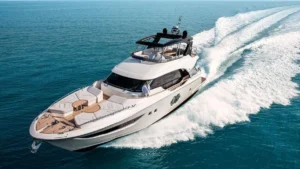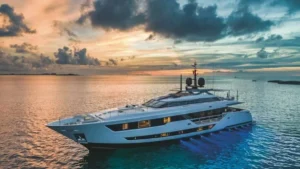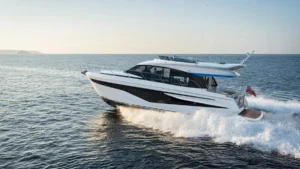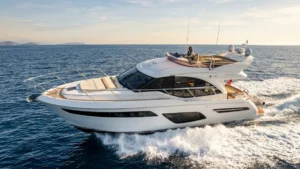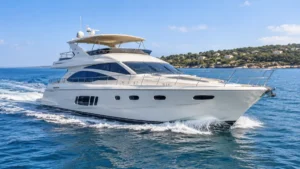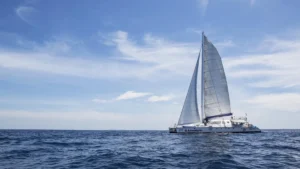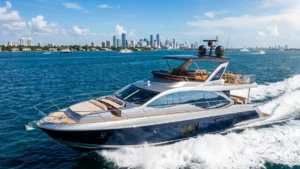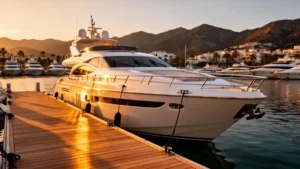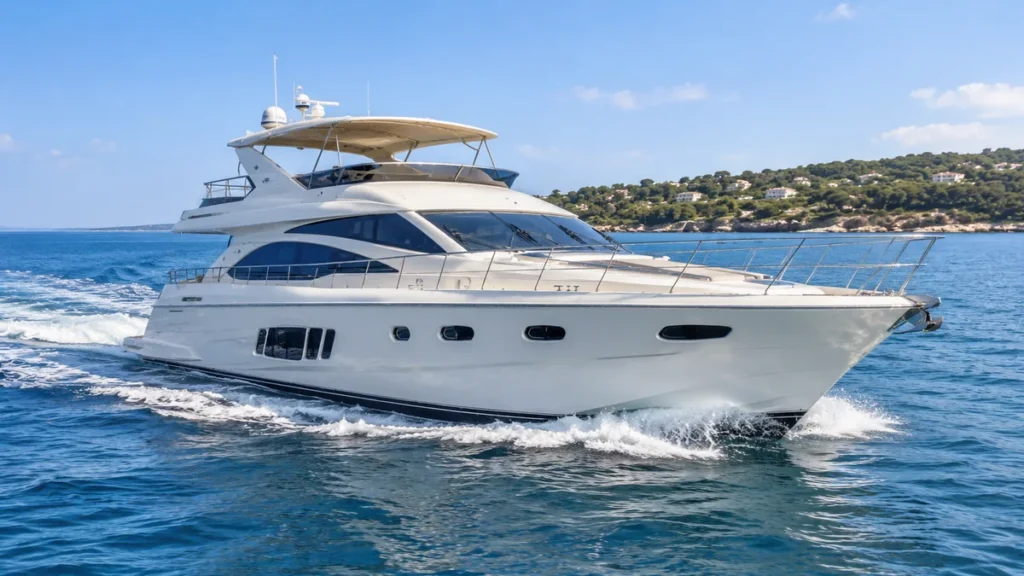
A 50-foot yacht is 15.24 metres long and offers more space than a small recreational boat. Depending on its design, it may have several cabins, bathrooms, a kitchen, indoor and outdoor seating, and equipment for longer trips.
However, not every 50-foot yacht has the same layout or purpose. Motor yachts use engines as their main source of propulsion, while sailing yachts rely mainly on sails and use an engine when needed. Some motor yachts have a flybridge, while others have an enclosed upper salon or a sport-focused design.
The purchase price also varies widely. Model, age, condition, engine or rig equipment, location, and maintenance history all affect the cost. This guide explains the main types, compares real models, and covers the expenses buyers should consider before purchasing a 50-foot yacht.
What Is a 50-Foot Yacht?
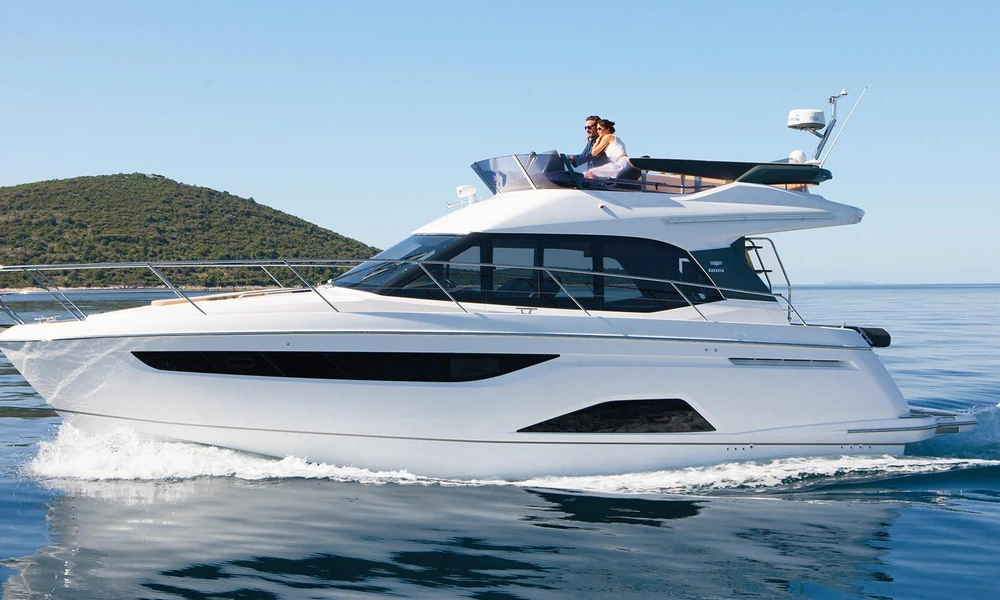
A 50-foot yacht is a recreational vessel in the 50-foot size class. The term describes its approximate length, not a standard layout, design, or level of luxury.
A 50-foot yacht may be a motor yacht or a sailing yacht. Motor yachts include different designs, such as flybridge and sport models. Sailing yachts have masts, sails, and rigging, and their layouts and operating requirements can differ considerably from powered yachts.
How Big Is a 50-Foot Yacht?
Fifty feet is exactly 15.24 metres. However, a yacht advertised as a 50-footer may have a different published overall length because manufacturers measure and describe length in different ways.
Important measurements include:
- Length overall (LOA): The yacht’s total length, although the exact measurement method can vary.
- Beam: The vessel’s maximum width.
- Draft: The distance from the waterline to the lowest part of the hull or keel.
- Air draft: The height from the waterline to the highest fixed point, which matters when passing under bridges.
- Displacement: The vessel’s weight under a stated loading condition.
These measurements affect marina access, storage, transport, and the places where the yacht can safely operate. Always check the manufacturer’s measurement notes for the exact model and configuration.
Main Types of 50-Foot Yachts
| Yacht type | Main features | Best suited to |
|---|---|---|
| Flybridge motor yacht | Main salon plus an upper deck, often with a second helm | Buyers who want separate indoor and outdoor areas |
| Sport or express motor yacht | Performance-focused design and connected social spaces | Faster powered cruising and day trips |
| Motor yacht with an upper salon | Enclosed upper living area connected to the cockpit | Entertaining and comfortable coastal cruising |
| Sailing yacht | Mast, sails, keel, and auxiliary engine | Buyers who want to sail and make longer passages |
| Sailing catamaran | Two hulls joined by a wide deck structure | Buyers who value interior space and a wide platform |
These categories describe different designs rather than separate, non-overlapping yacht classes. For example, a flybridge yacht is also a motor yacht.
How Much Does a 50-Foot Yacht Cost?
The 50-foot yacht price depends on its builder, model year, condition, equipment, location, and maintenance history. A used yacht may cost considerably less than a newer model, but its condition and future repair needs matter as much as its asking price.
There is no single reliable price for every 50-foot yacht. The following examples show how asking prices can differ even within one model range.
50-Foot Yacht Price Examples
| Yacht and model year | Advertised asking price | Condition or listing detail |
|---|---|---|
| 2019 Princess F50 | About $965,000 | Used listing in the UK |
| 2021 Princess F50 | About $1.45 million | Used listing in the United States |
| 2025 Princess F50 | About $1.70 million | Used listing in the United States |
| 2026 Princess F50 | About $2.05 million | Nearly new listing in Florida |
These are individual advertised prices, not confirmed sale prices or a market-wide average. Listings can change, and currency conversions may affect prices shown in different countries. Taxes, delivery, registration, and other purchase costs may also be separate.
A buyer should compare several current listings for the same model and similar model years before deciding whether an asking price is reasonable.
What Affects the Price of a 50-Foot Yacht?
Several factors can change the purchase price:
- Age and condition: A well-maintained older yacht may be a better purchase than a newer vessel with neglected systems.
- Builder and model: Brand reputation, design, construction, and demand can affect resale value.
- Engine or sailing equipment: Engine condition, engine hours, sails, rigging, and propulsion systems influence value.
- Onboard equipment: Generators, air conditioning, navigation electronics, stabilisers, and watermakers can add value.
- Location: Local demand, taxes, import duties, and delivery costs can change the final price.
- Service history: Complete maintenance records help buyers understand how the yacht has been cared for.
New vs. Used 50-Foot Yachts
| Factor | New yacht | Used yacht |
|---|---|---|
| Purchase price | Usually higher | Often lower |
| Customisation | More choice when ordering | Limited to existing equipment |
| Maintenance history | New service history | Depends on previous owners |
| Warranty | May include a manufacturer’s warranty | Depends on age and sale terms |
| Availability | May require a build or delivery wait | Can be available sooner |
| Inspection | Still requires careful checks | Requires close condition and maintenance checks |
A new yacht may appeal to buyers who want a particular layout and equipment package. A used yacht may offer a lower entry price, but buyers should budget for repairs, replacement equipment, and maintenance identified during inspection.
50-Foot Yacht Models to Compare
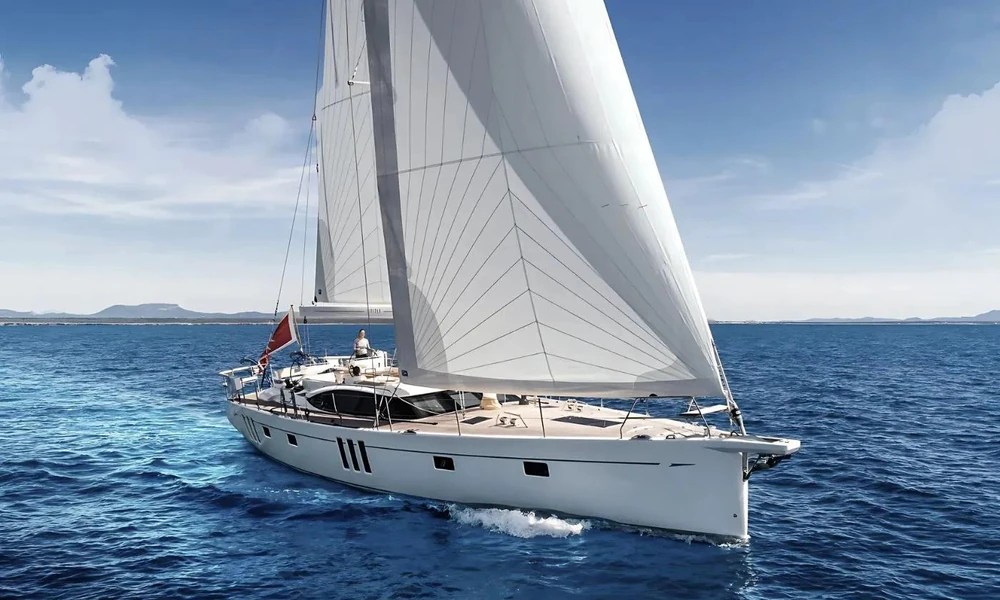
The following examples show how different a 50-foot motor yacht can be from a sailing yacht. They are not identical in purpose, and their measurements should not be treated as a direct performance comparison.
Princess F50
The Princess F50 is a flybridge motor yacht. Its design includes a main salon, a flybridge with seating and a second helm, and accommodation below deck.
The manufacturer’s published specifications include three cabins and six berths. The yacht has a forward stateroom and two additional cabins, with two cabins listed as en-suite. Its main salon includes a galley and a U-shaped sofa with a dining table.
The current manufacturer specification lists twin Volvo D8 IPS 800 engines, rated at 2 × 600 metric horsepower. Its published maximum speed range is 32–34 knots. Actual speed can vary with loading, hull condition, sea conditions, and other factors.
Cruisers Yachts 50 Cantius
The Cruisers Yachts 50 Cantius is a motor yacht with an upper salon and an open, connected main-deck layout. Its salon, galley, and cockpit are arranged to support movement between indoor and outdoor social areas.
The manufacturer lists three staterooms, including a full-beam master stateroom, a VIP stateroom, and a third guest stateroom. Its published features include a standard Seakeeper stabiliser and digital throttles with joystick control.
The manufacturer also lists a bridge clearance of 16 feet 1 inch, measured to the top of the mast light. Buyers should confirm the exact height of the yacht’s fitted equipment and any changes made after delivery.
Hallberg-Rassy 50
The Hallberg-Rassy 50 is a sailing yacht designed for longer-distance sailing. It has a hull length of 50 feet, although its published maximum length is 53 feet 7 inches.
The manufacturer’s data lists a standard draft of 2.35 metres, a 110-horsepower Yanmar auxiliary engine, and a sail area of 131.5 square metres with the standard genoa jib. A shallow-draft version is also available.
The manufacturer lists the model in CE Category A, which relates to its design category for ocean voyages. This classification does not mean that every voyage is automatically safe. Weather, loading, equipment, crew experience, and passage planning remain important.
50-Foot Yacht Specifications Comparison
| Specification | Princess F50 | Cruisers Yachts 50 Cantius | Hallberg-Rassy 50 |
|---|---|---|---|
| Yacht design | Flybridge motor yacht | Motor yacht with upper salon | Sailing yacht |
| Published length | 51 ft 4 in including pulpit; 49 ft 8 in excluding pulpit | 49 ft 5 in overall | 50 ft hull length; 53 ft 7 in maximum length |
| Beam | 14 ft 1 in (4.30 m) | 15 ft (4.57 m) | 16 ft 4 in (4.98 m), without rubrail |
| Draft | 4 ft 7 in (1.39 m) | 4 ft 4 in (1.32 m), full load | 7 ft 8½ in (2.35 m), standard |
| Fuel capacity | 488 US gal (1,850 L) | 454 US gal (1,719 L) | 264 US gal (1,000 L) |
| Water capacity | 113 US gal (428 L) | 111 US gal (420 L) | 248 US gal (940 L) |
| Propulsion | Twin Volvo D8 IPS 800 engines | Confirm engine specification for the exact boat | Yanmar 110 hp auxiliary engine |
| Published speed information | Maximum speed range 32–34 knots | No comparable figure stated here | Depends on sailing conditions and configuration |
Important measurement note: The Princess F50 length changes depending on whether the pulpit is included. The Cruisers 50 Cantius specification gives an overall length of 49 feet 5 inches but does not state the same pulpit measurement method. The Hallberg-Rassy 50 lists both hull length and maximum length. These figures should not be treated as identical measurement types.
50-Foot Yacht Interior and Exterior Features
The interior of a 50-foot yacht depends on its design and layout. A motor yacht may have a salon, galley, cabins, bathrooms, and outdoor seating. A sailing yacht may use more compact spaces and prioritise storage, access to equipment, and safe movement while underway.
Interior Features
Common interior areas can include:
- Salon: An indoor seating and dining area.
- Galley: A kitchen with cooking and food-storage equipment.
- Cabins: Private sleeping rooms for owners and guests.
- Bathrooms: Often called heads in boating terminology.
- Storage: Lockers and cupboards for clothing, supplies, and equipment.
The Princess F50, for example, has three cabins and six listed berths. The Cruisers 50 Cantius also has three staterooms, but its exact sleeping arrangements should be checked against the selected layout and specification.
Exterior Features
Depending on the model, exterior areas may include:
- A cockpit for seating and access to the water
- A bow lounge or foredeck seating area
- A flybridge or upper-deck seating area
- A swim platform
- A helm station
- Deck storage and safety equipment
A sailing yacht has additional exterior equipment, including a mast, sails, winches, and rigging. Buyers should check that these parts are in good condition and suitable for the intended sailing plans.
How Many People Can a 50-Foot Yacht Accommodate?
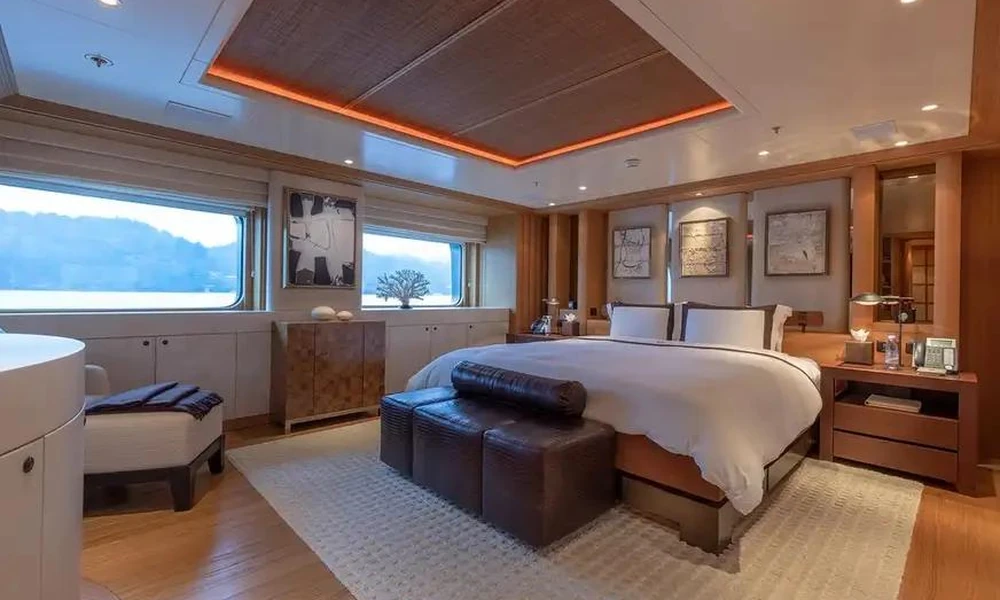
A 50-foot yacht may have several cabins and sleeping berths, but the number of people it can safely carry is not the same as its sleeping capacity.
These terms describe different things:
- Cabins or staterooms: Separate sleeping rooms.
- Berths: Individual sleeping places.
- Guest capacity: The number of people the yacht is designed or approved to carry under the relevant conditions.
For example, the Princess F50 manufacturer lists six berths across three cabins. That does not automatically mean six is the yacht’s maximum legal passenger capacity, or that every berth is suitable for every type of trip.
Check the yacht’s builder documentation, capacity plate where applicable, safety equipment, and local regulations before carrying guests.
How Fast Is a 50-Foot Yacht?
The speed of a 50-foot yacht depends on its hull design, engines, weight, weather, and operating conditions.
A motor yacht may have a published maximum speed, but that figure is not the same as its normal cruising speed. Operating at maximum speed can also increase fuel use.
The Princess F50 manufacturer publishes a maximum speed range of 32–34 knots. This is a manufacturer estimate, not a guaranteed speed for every boat. The actual result depends on loading, hull cleanliness, sea conditions, and other factors.
A sailing yacht works differently. Its speed depends on wind strength and direction, sail selection, sea conditions, hull design, and the skill of the crew. Buyers should review manufacturer performance information and, where possible, arrange a sea trial.
50-Foot Yacht Fuel Consumption
Fuel consumption is not the same as fuel capacity. Fuel capacity tells you how much fuel the tanks can hold, while consumption tells you how quickly the engines use it.
Consumption varies with speed, engine type, hull condition, load, weather, and maintenance. A yacht travelling faster will generally use more fuel than the same yacht travelling at a slower, more efficient speed.
The following example is an illustration, not a measured figure for the Princess F50 or Cruisers 50 Cantius.
| Item | Value |
|---|---|
| Illustrative fuel consumption | 30 US gallons per hour |
| Operating time | 100 hours |
| Total fuel consumed | 3,000 US gallons |
At this illustrative rate, 100 hours of operation would use 3,000 US gallons. That is several tankfuls for a yacht with a 454- or 488-US-gallon tank. The example does not account for reserve fuel or changes in consumption during a trip.
Before buying a 50-foot motor yacht, ask the seller or manufacturer for fuel-consumption information at different engine speeds. For a sailing yacht, also check engine fuel use under power and the vessel’s actual sailing performance.
50-Foot Yacht Running Costs
The purchase price is only one part of owning a yacht. Running costs can include fuel, insurance, marina fees, maintenance, repairs, winter storage, and crew.
The total depends on how often the yacht is used, where it is kept, and whether the owner operates it or employs professional help.
| Expense | What it covers |
|---|---|
| Fuel | Engine use, generator use, and fuel for onboard equipment |
| Marina or mooring | Berthing, utilities, and related marina services |
| Maintenance | Scheduled servicing and routine upkeep |
| Repairs | Work needed to fix worn, damaged, or failed equipment |
| Insurance | Cover based on the yacht, location, use, and policy |
| Crew | Captain or other paid crew, if required |
| Winter storage | Haul-out, storage, and seasonal preparation where applicable |
| Equipment replacement | Electronics, batteries, sails, safety equipment, and other items |
Annual Maintenance and Repairs
Maintenance requirements vary between motor and sailing yachts.
A motor yacht needs regular engine and generator servicing, checks of propulsion systems, and inspections of electrical, plumbing, air-conditioning, and safety equipment.
A sailing yacht needs these checks too, along with inspections of sails, mast, standing rigging, running rigging, winches, and deck fittings. The replacement schedule depends on use, age, condition, and manufacturer guidance.
Unexpected repairs are a separate budgeting concern. A survey may identify issues that need immediate attention, while other problems can appear during ownership. Keep a financial reserve rather than assuming that the purchase price covers every future expense.
What to Check Before Buying a 50-Foot Yacht
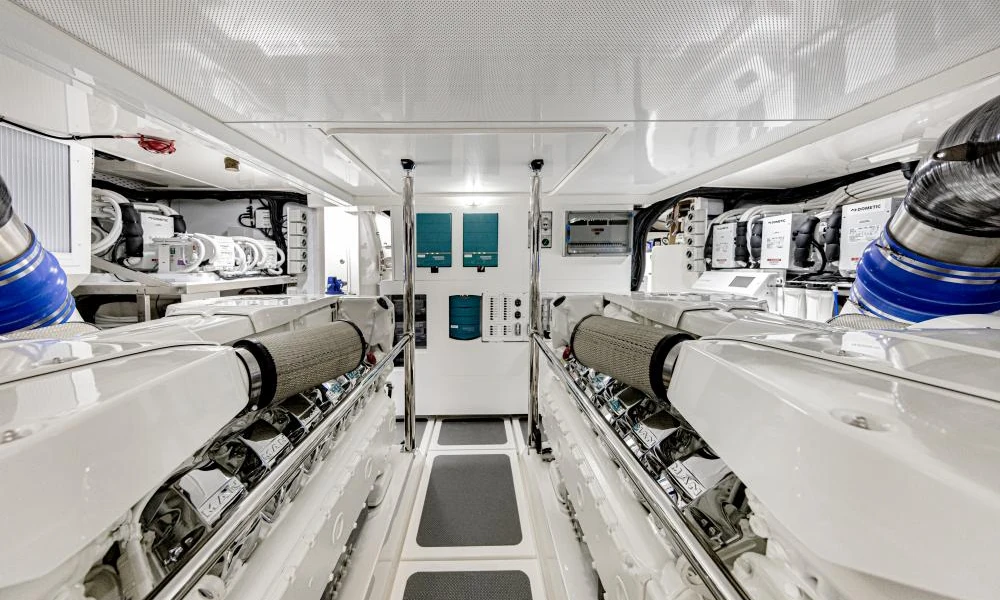
A yacht can look attractive in photographs and still have costly problems. Arrange an independent marine survey and a sea trial before completing a purchase.
1. Inspect the Hull and Structure
Check the hull, deck, windows, fittings, and visible structural areas for damage, leaks, corrosion, or signs of poor repairs. The inspection method should suit the yacht’s construction material.
2. Check the Engines and Mechanical Systems
For a motor yacht, review engine hours, service records, cooling systems, transmissions, steering, and generator condition. Have a qualified marine engineer inspect the machinery.
For a sailing yacht, inspect the auxiliary engine and its supporting systems as well as the sailing equipment.
3. Inspect Sails and Rigging
For a sailing yacht, check the condition and age of the sails, mast, standing rigging, running rigging, winches, and deck fittings. Ask for maintenance or replacement records. A specialist rig inspection may be appropriate.
4. Test Electrical and Navigation Equipment
Check navigation screens, radar, GPS, batteries, chargers, lighting, communication equipment, and other installed electronics. Confirm that the equipment works and that the documentation is available.
5. Check Plumbing and Living Systems
Test freshwater pumps, toilets, holding tanks, water heaters, air conditioning, and other onboard systems. Look for leaks, unusual smells, and signs of water damage.
6. Arrange a Sea Trial
A sea trial lets the buyer assess the yacht underway. For a motor yacht, observe engine operation, steering, vibration, handling, and system performance. For a sailing yacht, assess sailing controls and handling under appropriate conditions, as well as engine operation.
7. Review Documents and Ownership Costs
Check ownership documents, registration, tax status, maintenance records, equipment inventory, insurance requirements, and any outstanding finance or legal issues. Ask for written estimates of expected repairs before agreeing on the final price.
Is a 50-Foot Yacht Right for You?
A 50-foot yacht can suit buyers who want more onboard space than a smaller boat can provide. However, its size also brings higher purchase, maintenance, storage, and operating responsibilities.
A motor yacht may suit someone who prefers powered cruising and wants a layout with a salon, cabins, and outdoor seating. A sailing yacht may suit someone who wants to sail and has, or is willing to develop, the skills needed to manage sails and rigging.
Consider the following before buying:
- Your experience: A yacht of this size may require more handling skill than a smaller boat.
- Your intended trips: Coastal trips, extended cruising, and ocean passages have different requirements.
- Your budget: Include purchase costs, running costs, repairs, insurance, and storage.
- Your berth: Check length, beam, draft, and air draft against the marina or mooring.
- Your crew needs: Whether you need a captain depends on your experience, the yacht, the trip, and local rules.
Do not assume that every 50-foot yacht is suitable for an ocean crossing. Check its design, range, seaworthiness, safety equipment, condition, and the crew’s experience before planning a long passage.
Conclusion
A 50-foot yacht can be a motor yacht with a flybridge or upper salon, or a sailing yacht designed for powered or wind-driven travel. Its layout, performance, and ownership costs depend on the exact model and condition.
Before choosing a 50-foot yacht for sale, compare the manufacturer’s specifications, check current asking prices, and calculate the likely running costs. Pay close attention to length measurement, beam, draft, fuel capacity, accommodation, and the equipment included.
An independent marine survey, specialist mechanical or rig inspection, and sea trial can help you understand the yacht’s condition before purchase. The best choice is the vessel that fits your intended use and long-term budget.
Frequently Asked Questions
1. How much does a 50-foot yacht cost?
There is no fixed price. A used 50-foot yacht may cost substantially less than a new or nearly new model. For example, advertised Princess F50 listings have ranged from about $965,000 for a 2019 model to about $2.05 million for a 2026 model. These are individual asking prices, not confirmed sale prices or a universal market range.
2. Is a 50-foot yacht considered a luxury yacht?
Some 50-foot yachts are marketed as luxury yachts because they offer private cabins, indoor living areas, modern equipment, and comfortable outdoor spaces. However, the term luxury does not describe a fixed technical category. Features and finish vary by builder and model.
3. Can one person operate a 50-foot yacht?
Some experienced owners may be able to operate a particular yacht without a full-time crew, especially with suitable handling systems. However, safe operation depends on the vessel, conditions, the owner’s training, and local rules. Buyers should get proper training and understand the yacht’s operating requirements.
4. Can a 50-foot yacht run its air conditioning without shore power?
It depends on the yacht’s electrical system. Air conditioning can usually operate away from shore power if the yacht has a suitable generator or an appropriately designed inverter and battery bank. Battery capacity, inverter rating, air-conditioning load, and operating time all matter. Ask the manufacturer or a marine electrician to confirm what the installed system can support.
5. How long can a 50-foot yacht stay at sea?
There is no universal time limit. Endurance depends on fuel and water capacity, food storage, power generation, weather, crew, and the yacht’s design. A sailing yacht may travel differently from a motor yacht, and both require suitable planning for the intended passage.
6. Can a 50-foot yacht be transported by road?
Road transport is possible in some circumstances, but it requires specialist planning. A 50-foot yacht may need a heavy-duty transport trailer, a suitable route, and permits for an oversize load. A beam of 14–15 feet is wider than typical road-width limits, so escorts or other special arrangements may be required depending on the country and route. Mast, height, weight, lifting, and bridge restrictions must also be checked.
7. Can a 50-foot yacht cross an ocean?
Some sailing yachts and motor yachts around this size are designed for offshore or ocean passages, but length alone does not prove that a yacht is suitable. Buyers should review the vessel’s design category, range, fuel and water capacity, safety equipment, condition, and documented capabilities. Crew experience, weather, and passage planning are also essential.
8. Is an older 50-foot yacht worth buying?
An older yacht can be worth considering if it has been maintained properly and its price reflects its condition. Review its service history, engine or rig condition, structural areas, equipment, and likely repair costs. An independent survey can help identify problems before purchase.