

The global luxury marine market is experiencing a massive shift in how owners evaluate life at sea. Meanwhile, the classic romance of a single-hulled vessel slicing through waves still captures the imagination. However, a growing majority of modern buyers are looking toward the massive stability of multi-hull designs. In this comprehensive comparison, we analyze the ultimate debate of catamaran vs monohull yacht to help you make the right investment for the current season.
Consequently, the final decision depends entirely on your specific lifestyle goals, cruising grounds, and comfort priorities. Today, the debate over monohull vs catamaran performance is no longer just about aesthetics. Instead, it represents a fundamental choice between raw sailing tradition and expansive, apartment-like living space. Furthermore, based on available market data, the newest best catamaran 2026 models are successfully challenging traditional monohulls in areas like fuel efficiency, shallow-water exploration, and off-grid autonomy.
If you want to understand which hull shape deserves your hard-earned capital, this guide breaks down the financial and practical realities of catamaran yacht buying this year.
The Space and Comfort Reality: Living on Two Hulls
When you evaluate a modern catamaran vs monohull, the most immediate difference hits you the second you step out into the main living areas. The wide footprint of a multi-hull design completely changes how naval architects distribute space.
The Wide-Open Main Salon: A multihull carries its beam uniformly from the stern to the bow. As a result, you get a massive, open-plan main deck where the galley, dining area, and cockpit sit on a single level.
Complete Natural Light: Because the salon sits high up on the bridge deck rather than down in a deep hull, designers can use wrap-around windows. Therefore, the interior spaces flood with natural light while offering 360-degree views of the horizon.
Separated Living Quarters: The sleeping staterooms sit entirely inside the parallel hulls. This arrangement creates excellent acoustic privacy, making it perfect for families or charter groups who want their own quiet areas.
Conversely, a classic monohull naturally limits your layout options. Because the living spaces sit entirely down inside a single, tapering hull, you must walk down stairs to access the galley and staterooms. Consequently, this can sometimes create a darker, more confined atmosphere on smaller vessels. However, larger custom superyachts still deliver spectacular volume by using multiple vertical decks.
Seakeeping Performance: Bouncing vs. Heeling
The mechanical behavior of these two hull forms in open water impacts your onboard comfort dramatically. Specifically, it dictates whether your guests enjoy their time at anchor or suffer from motion sickness.
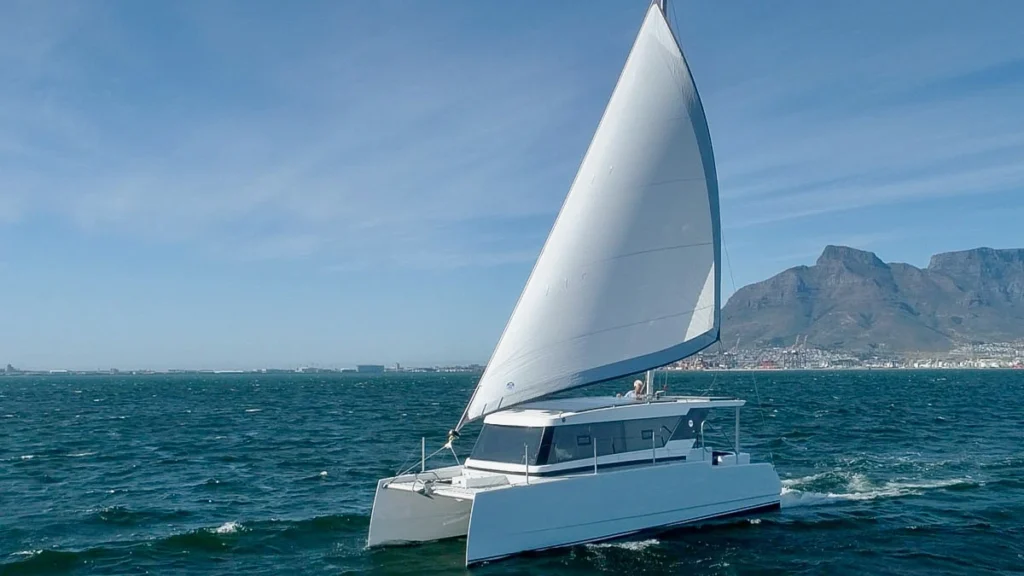
The Monohull Experience
A traditional single-hull vessel leans, or heels, into the wind when under sail. For purists, this connection to the elements represents the ultimate thrill of ocean navigation. Monohulls slice cleanly through choppy head seas with a natural, predictable motion. However, this means the entire interior remains tilted while underway. Thus, performing simple daily tasks like cooking or walking across the cabin requires much more physical effort.
The Catamaran Stability Advantage
Multi-hulls do not heel. Instead, they remain completely flat on the water, rarely leaning more than a few degrees even in high winds. This extreme stability represents a massive advantage for long-range cruising comfort. Furthermore, at anchor, they resist the annoying side-to-side rolling motion that plagues single-hull vessels in crowded bays.
However, you must consider the trade-off. In short, choppy head seas, a multihull can experience a quick, jerky motion as each hull reacts to separate waves.
The Power Revolution: The Rise of the Power Catamaran
The fastest-growing segment of the modern marine industry is the dedicated power catamaran. For years, long-range cruisers relied on traditional single-hull trawlers. Today, builders are combining massive interior volume with advanced hydrodynamics to create highly efficient long-range cruisers.
Because twin hulls are exceptionally slim, they create significantly less hydrodynamic drag than a wide, heavy monohull. Therefore, a modern multihull can achieve the same cruising speeds as a monohull while using up to 30% to 40% less fuel. Furthermore, this efficiency allows premium brands like Sunreef Yachts to integrate massive solar panel arrays directly into the composite bodywork. This green tech allows owners to run onboard air conditioning for hours completely silent without generators.
Financial and Practical Comparisons
To help you analyze the market clearly, we have compiled a detailed breakdown of how these two configurations stack up against each other across essential ownership categories:
| Ownership Category | Catamaran Performance | Monohull Performance |
| Interior Volume | Exceptional; typically offers the living space of a 15-foot larger monohull. | Moderate; space is focused vertically rather than horizontally. |
| Shallow-Water Access | Excellent; ultra-shallow drafts allow you to anchor right next to the beach. | Restricted; deep ballasted keels require you to stay far away from shallow reefs. |
| Marina Berthing Costs | High; double beams often require you to pay for two slips or a premium end-tie. | Standard; narrow profiles fit into standard, affordable marina slips easily. |
| Redundancy and Safety | Complete; standard twin engines and twin steering systems provide built-in backups. | Limited; most single-hull motor vessels rely on a single main engine setup. |
| Resale Value Stability | High; intense global demand keeps pre-owned multihull prices exceptionally strong. | Moderate; steady supply means you must price your vessel competitively to sell. |
Top Multihull Models Dominating the Market
The current year boasts an incredible lineup of newly delivered vessels designed to push boundaries. Specifically, the following models represent the absolute peak of multihull design for anyone browsing the current market:
1. Aquila 50 Sail
Making a massive splash at recent global boat shows, the newly introduced Aquila 50 Sail marks an exciting new chapter for the builder. Known globally for their elite power designs, Aquila successfully transitions their structural expertise into the sailing market. This model features an innovative bridge-to-bow direct access walkway, a massive flybridge lounge, and an exceptionally efficient sail plan. It serves buyers who want premium luxury wrapped in a highly capable bluewater hull.
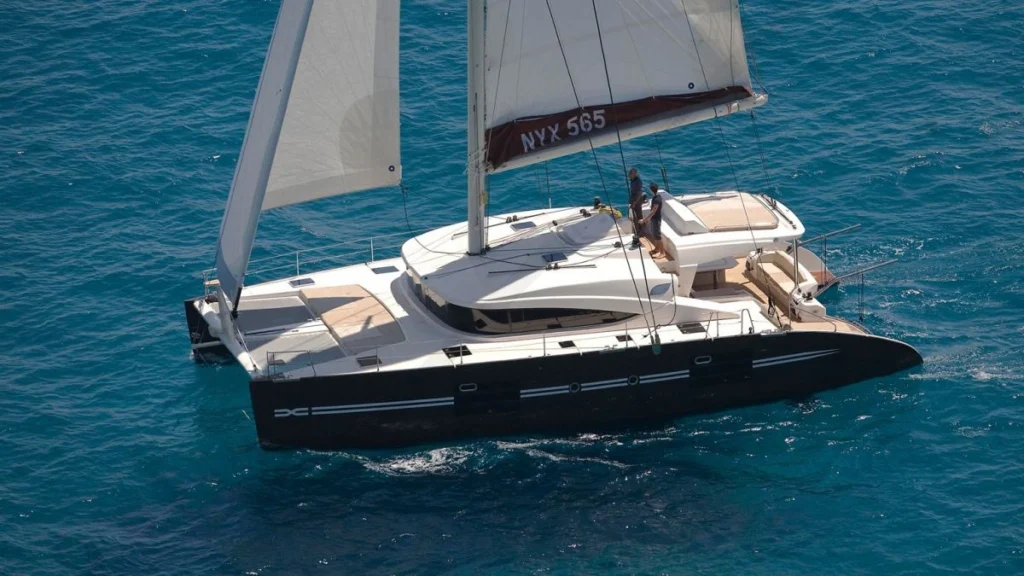
2. Leopard 53 Powercat
Refreshed for the current season, the Leopard 53 Powercat continues to define the luxury cruising class. Powered by twin 370-horsepower Yanmar engines, this vessel easily achieves a top speed of 24 knots while maintaining long-range fuel efficiency. The layout offers an expansive, air-conditioned interior salon and a massive flybridge deck equipped with a full outdoor galley. Consequently, it stands out as an excellent choice for extended family island-hopping.
3. Sunreef 60 Eco
Standing as a true pinnacle of green engineering, this custom luxury multihull features the world’s first composite-integrated solar panel system. The hull skin actively harvests clean energy from the sun to power the advanced lithium battery banks. Therefore, owners can enjoy silent, emission-free cruising through protected marine sanctuaries. The interior is fully bespoke, showcasing premium sustainable finishes and superyacht-level craftsmanship.
Summary: Making Your Ultimate Choice
In conclusion, the decision between these two formats comes down to how you plan to use the vessel. If you are a traditionalist who loves the athletic feel of a heeling boat, a monohull remains unmatched. It also saves you considerable money on annual marina slip fees.
Ultimately, if your primary goals are maximum living space, absolute stability at anchor, shallow-water capability, and long-range efficiency, the catamaran wins hands down. It delivers a modern, luxurious platform that feels much more like a floating waterfront villa than a cramped boat.
If you are ready to explore more comprehensive luxury vessel analysis, performance reviews, and high-end automotive or marine engineering news, make sure to visit our main digital hub over at turboocruiser.
Frequently Asked Questions (FAQs)
Why are marina slip fees more expensive for a catamaran?
Marinas charge you based on the total footprint of the vessel. Because a multihull features a massive beam that is often twice as wide as a comparable monohull, it takes up significantly more physical space. Consequently, you will often have to pay for a double-wide slip or secure a premium end-tie position, which increases your monthly dockage costs.
Which hull design handles rough storm conditions better?
Both configurations are exceptionally safe when engineered properly by premium shipyards. A ballasted monohull features a heavy keel, which makes it virtually impossible to capsize permanently because it naturally rights itself. On the other hand, a multihull relies on structural width for stability. It provides a much more stable platform in massive swells, but it requires active seamanship to manage the sails properly in extreme winds.
Can I operate a large 50-foot power catamaran without a professional crew?
Yes, you can easily handle a modern 50-foot multihull as an owner-operator. Because the twin engines sit exceptionally far apart in the parallel hulls, you gain incredible leverage when maneuvering at low speeds. By adjusting the throttles independently, you can easily spin the entire vessel 360 degrees inside its own length, making tight marina docking incredibly simple.
Is the resale value better for a multi-hull or a single-hull vessel?
Based on current market data, premium multihulls hold their value exceptionally well. The global demand for charter fleets and private liveaboard buyers vastly outpaces the production capacity of the top shipyards. Therefore, well-maintained pre-owned multihulls experience very little depreciation compared to standard production monohulls on the secondary market.