
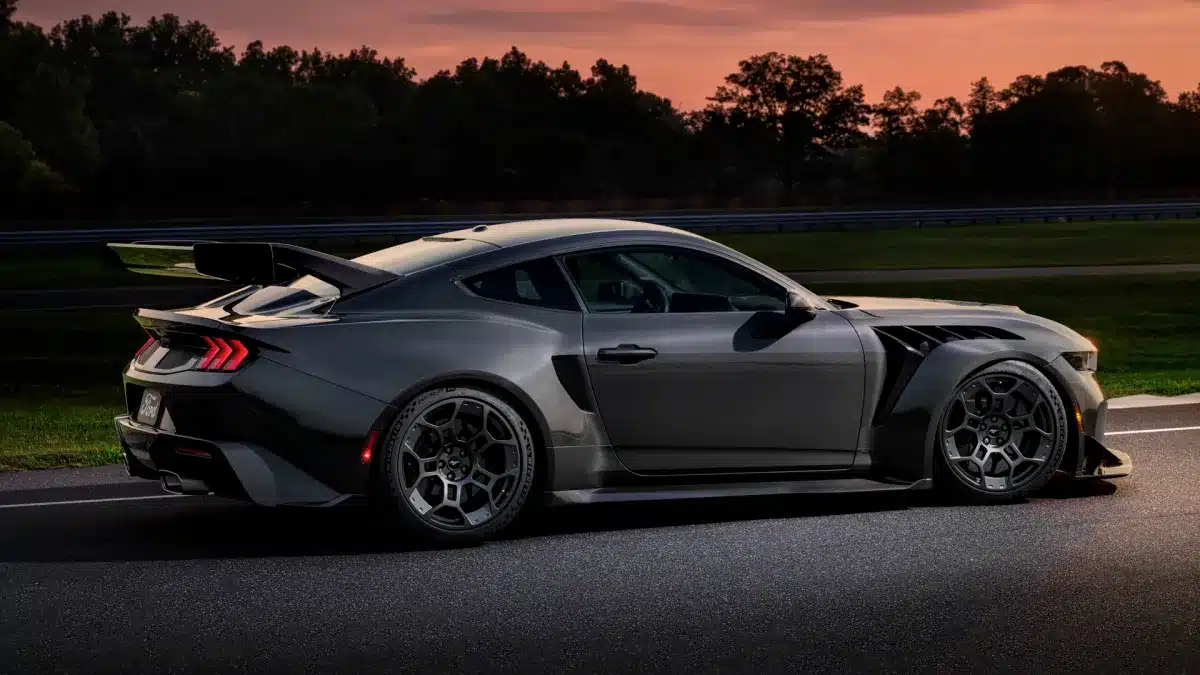
The high-performance automotive world has a new king. Strikingly, it does not come from Stuttgart or Maranello. It comes straight from Detroit.
The ford mustang gtd 2026 is the most extreme street car Ford has ever created. Far from a basic muscle car, it is a factory-built racing weapon with license plates. Ford engineered this vehicle to achieve one specific goal: to humble the legendary Porsche 911 GT3 RS on the track.
This vehicle breaks traditional rules by using advanced technology that professional racing series actually ban. For track enthusiasts, it represents the absolute peak of modern American engineering. This comprehensive ford gtd review closely analyzes how this machine redefines track performance.
The Audacious Origin Story
The supercar began life as a highly classified project. A small, dedicated group of engineers gathered secretly inside a hidden storage garage. They aimed to design an American car that could comfortably out-corner elite European track machines. Therefore, they avoided focusing on traditional drag racing metrics to prioritize pure lateral handling.
Ford quickly partnered with the legendary motorsports company, Multimatic. This firm is famous for building world-class race cars. Previously, they manufactured the iconic Ford GT supercar alongside the official Mustang GT3 endurance racers.

The engineering team completely overhauled the standard mass-market Mustang chassis. They chose to preserve only the basic cabin silhouette, sacrificing every ounce of everyday practicality, the same trade-off we explore in our luxury SUV vs sports car comparison. Ultimately, the partnership yielded a vehicle that looks deeply intimidating and performs flawlessly.
Breaking Down the Massive Financial Cost
Owning this historical piece of American motorsport requires an immense financial investment. The baseline mustang gtd price officially starts at a staggering $325,000 before taxes.
This pricing structure moves the car into an entirely new market territory. For context, it costs significantly more than a standard Porsche 911 GT3 RS. It even eclipses the price tag of multiple mid-engine exotic supercars.
Furthermore, you cannot simply purchase this vehicle at a local dealership. Buyers must go through a highly selective application process instead, placing it in the same exclusive ownership tier as the models featured in our expensive cars that start with C guide. Specialized allocations like the exclusive Carbon Series push final transaction prices well past $400,000.
Mind-Blowing Mustang GTD Horsepower
The true soul of this vehicle lives beneath its heavily vented carbon-fiber hood. Ford selected a specialized, hand-built 5.2-liter supercharged V8 engine.
This engine is a deeply modified variation of the famous Predator V8 motor. Crucially, engineers added an advanced dry-sump oiling system to the engine block. This mechanical upgrade marks the first time such technology has appeared in a road-going Mustang. It keeps vital oil flowing perfectly during sustained, high-G cornering forces on a racetrack.
The engine delivers an astounding official mustang gtd horsepower rating of 815 horsepower a figure confirmed directly on Ford’s official Mustang GTD page. Additionally, it generates a ferocious 664 pound-feet of torque, a supercharged approach quite different from the BMW X5 M60i’s twin-turbo V8, which prioritizes daily comfort over raw track output. These massive power figures officially establish it as the most powerful factory Mustang ever sold.
The supercharger uses a smaller pulley system to maximize total boost pressure. Similarly, the custom intake system breathes far more efficiently than standard configurations. A lightweight titanium Akrapovič exhaust system provides a truly deafening, aggressive sound profile. Consequently, the car rocketed from zero to 60 mph in under 3.5 seconds during testing.
Unbelievable Engineering and Mustang GTD Specs
The mechanical layout of this vehicle completely abandons traditional muscle car design rules. Normal street cars mount their heavy transmission directly behind the front engine. The GTD changes this design layout entirely to optimize weight distribution.
Engineers moved the heavy eight-speed dual-clutch transmission directly to the rear axle. A lightweight carbon-fiber driveshaft connects the front engine to this rear-mounted transaxle layout. This structural configuration delivers a near-perfect 50/50 front-to-rear weight balance. As a result, the front engine balances its mass like a mid-engine exotic vehicle.
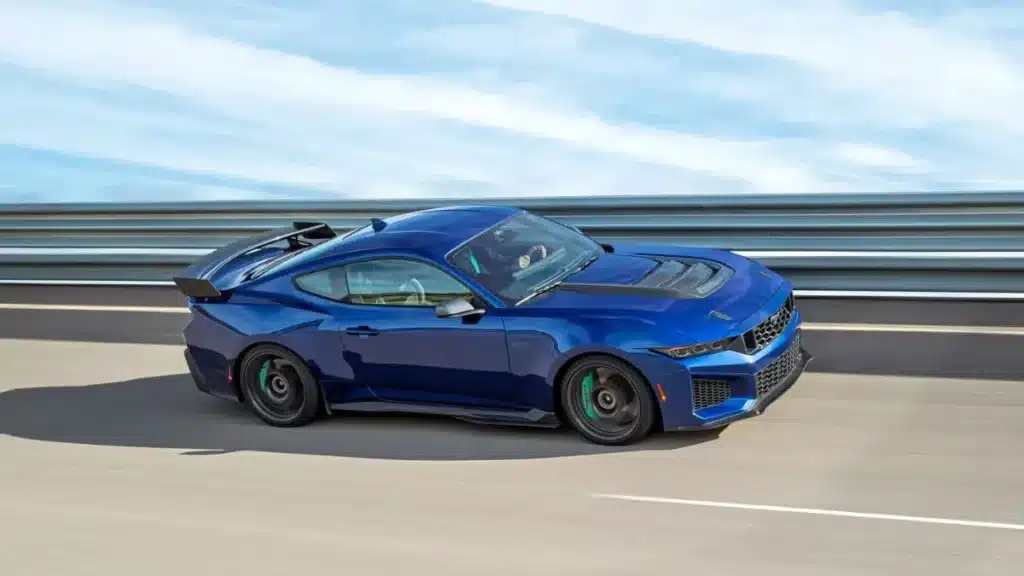
The highly detailed mustang gtd specs showcase an absolute obsession with weight reduction. Almost every single exterior body panel consists of rigid carbon fiber. The front fenders display massive cooling vents designed to exhaust extreme wheel-arch pressure. Additionally, a widebody stance makes the car 150 millimeters wider than a standard Mustang.
The traditional rear trunk space is entirely absent. In its place sits a state-of-the-art pushrod rear suspension system. This semi-active suspension utilizes advanced adaptive spool valve dampers. Drivers can even observe these mechanical components working through a clear glass window inside the cabin.
A built-in hydraulic system drops the track ride height by 40 millimeters in mere seconds. It simultaneously stiffens the internal spring rates to maximize track handling capability. The vehicle rides on ultra-wide Michelin Pilot Sport Cup 2R track tires. Finally, massive Brembo carbon-ceramic brakes provide relentless, fade-free stopping power.
Conquering the Brutal Nurburgring Circuit
Ford did not design this machine to collect dust inside a static museum. They built it to dominate the most dangerous racetrack on earth. That track is the iconic Nürburgring Nordschleife circuit in Germany.
The vehicle set an official gtd nurburgring lap time that completely stunned the global automotive industry. Driven by professional racer Dirk Müller, the car completed the legendary circuit in 6 minutes and 40.835 seconds.
This historic run made it the first American production vehicle to break the legendary seven-minute barrier. It successfully defeated the lap records of multiple million-dollar European hypercars.
This blistering speed stems directly from advanced active aerodynamics. The enormous rear wing mounts directly to the reinforced roof pillars. It utilizes a hydraulic drag reduction system identical to modern Formula One race cars. The rear wing adjusts its angle instantly to balance straightaway speed and cornering downforce. Meanwhile, extensive underbody carbon panels effectively suck the chassis directly to the tarmac.
The Real-World Driving Experience
Stepping inside the cockpit feels exactly like entering a professional endurance racing machine. The race-focused interior features premium Recaro bucket seats designed to hold you tightly. The steering wheel hosts massive titanium paddle shifters for manual gear selection. Interestingly, Ford crafted these components using recycled titanium from retired military fighter jets.
On public roads, the car feels incredibly wide, aggressive, and uncompromising. The loud titanium exhaust system screams intensely even at lower engine RPMs, a stark contrast to the comfort-first priorities covered in our safest luxury cars guide. Clearly, this vehicle completely ignores daily comfort to focus entirely on mechanical speed.
On an open circuit, the vehicle immediately transforms into a precise track weapon. The supercharged V8 engine delivers instant, explosive power out of every corner. The dual-clutch transmission shifts gears with crisp, lightning-fast precision. Front-end steering grip is thoroughly spectacular. Thus, you can carry immense speed directly into tight apexes.

The advanced electronic track management systems let drivers adjust traction thresholds effortlessly on the fly. Drivers can gradually raise their cornering limits as they learn the chassis behavior. It delivers the intense performance of a true race car alongside the raw soul of an American V8.
Conclusion
The ford mustang gtd represents a historic milestone for global automotive culture. It completely shatters old stereotypes regarding what an American muscle car can achieve. By pairing an 815-horsepower supercharged V8 engine with a professional racing chassis, Ford created a genuine masterpiece.
It remains an incredibly expensive and highly exclusive machine. It completely lacks storage space and rides firmly on public asphalt. However, those minor compromises fade away completely the moment you enter a racetrack pit lane. It does not simply challenge elite European supercars. It defeats them convincingly on their own turf. for more information visit Turboocruiser.
FAQs
What is the official mustang gtd price?
The base manufacturer suggested retail price starts at $325,000. However, adding highly customized options will increase that cost significantly. Choosing the premium Carbon Series, for instance, pushes final pricing over $428,000. Consequently, this model enters true exotic supercar territory.
How much mustang gtd horsepower does the V8 engine make?
The hand-built 5.2-liter supercharged V8 engine officially delivers 815 horsepower. Furthermore, it generates an impressive 664 pound-feet of torque. This massive output makes it the most powerful factory Mustang ever created. Ultimately, this muscle car outperforms many traditional track cars.
What are the core mustang gtd specs to know?
First, engineers moved the eight-speed dual-clutch transaxle to the rear chassis. This clever placement gives the vehicle a perfect 50/50 weight balance. Additionally, the body panels feature lightweight carbon fiber. An advanced pushrod suspension setup replaces the traditional trunk space entirely.
What was the official gtd nurburgring lap time?
The vehicle conquered the legendary German circuit in exactly 6 minutes and 40.835 seconds. Because of this incredible run, it shocked the European racing community. It stands as the fastest street-legal American production car in history. Therefore, its track dominance is officially proven.
Is the Ford Mustang GTD street legal?
Yes, this vehicle fully meets all legal production car regulations. It retains its street-legal status despite using aggressive aerodynamic parts. For example, the massive rear wing comes directly from the GT3 race car. Thus, you can legally drive this track monster on public roads.
Where is the vehicle assembled?
Initial manufacturing work begins at the Ford Flat Rock Assembly Plant in Michigan. After that, the cars travel to Canada for specialized upgrades. The expert engineering teams at Multimatic finish the build process by hand. Consequently, each vehicle receives elite racing-grade attention.