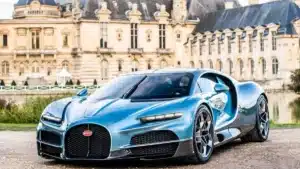
Bugatti is a French marque that builds some of the fastest and most exclusive cars on earth. Ettore Bugatti started the company in 1909, and its reputation has always rested on a mix of daring engineering, elegant design, and speed. Modern milestones include the Veyron, the Chiron, the Divo, the track-only Bolide, and the W16 Mistral roadster.
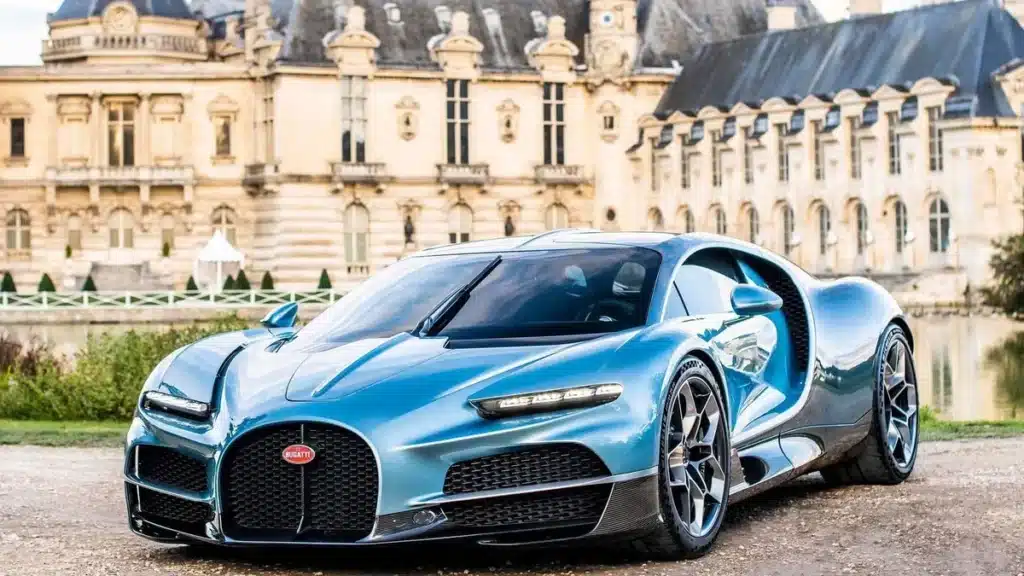
The brand has now opened a new chapter with the Tourbillon, a plug-in hybrid whose naturally aspirated V16 works alongside three electric motors. Tiny production runs and extensive personalization keep every Bugatti rare.
What Is Bugatti?
Bugatti is a luxury manufacturer that concentrates on hypercars. Its cars are known for huge power, record-setting speed, refined interiors, and very small build numbers. Instead of chasing volume, the company makes a handful of cars at a time, and many of them are sold before the public sees them.
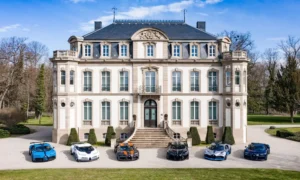
The brand’s historic home is Molsheim, a town in the Alsace region of France. Bugatti has built its modern cars there since the early 2000s, and the site also houses the Château Saint Jean. Since 2021 the marque has belonged to Bugatti Rimac, a company led by Mate Rimac.
History of Bugatti
The Founder and the Racing Years

Ettore Bugatti was born in Milan and trained as a designer and engineer. In 1909 he set up his own factory in Molsheim, which was then part of the German Empire and later became French. He held that a car should be both a technical achievement and a beautiful object.
Racing made the name famous in the 1920s and 1930s. The Type 35 became one of the most successful Grand Prix cars of its time, collecting a long list of victories. Road cars added to the legend, including the enormous Type 41 Royale and the Type 57 SC Atlantic, which is still regarded as one of the most beautiful cars ever made.
Tragedy followed. Ettore’s son Jean, a gifted designer, died in 1939, and Ettore himself died in 1947. The firm never recovered its footing after the war, and the last cars of the original era were built in the mid-1950s.
The Italian Revival
In 1987 the Italian entrepreneur Romano Artioli bought the Bugatti name and founded a new company, building a factory at Campogalliano near Modena. Its showpiece was the EB110, unveiled in Paris on September 15, 1991, which was the 110th anniversary of Ettore’s birth. The car had a quad-turbocharged V12 and all-wheel drive, and it was very advanced for its day. Even so, the company went bankrupt in 1995.
The Volkswagen Era
Volkswagen Group acquired the brand in 1998 and moved it back to Molsheim. After several concept cars, the Veyron went on sale in 2005. Its 8.0-liter W16 engine had four turbochargers and made 1,001 PS, and it was the first production car to be built around a top speed above 400 km/h. A faster Super Sport arrived in 2010, setting a production-car record of 431 km/h. Production ended in 2015 at 450 cars, made up of 300 coupes and 150 roadsters.
The Chiron followed in 2016. It raised output to 1,500 PS, and the Super Sport 300+ prototype became the first car to pass 300 mph, reaching 490.484 km/h in August 2019. The 500th and final Chiron, called L’Ultime, was finished in 2024.
A New Structure
In 2021 Bugatti joined forces with Rimac Automobili to form Bugatti Rimac. The first fruit of that partnership was the Tourbillon, which was introduced in June 2024 and moves from the W16 to a V16 hybrid.
Who Owns Bugatti?
Ownership has changed repeatedly. Volkswagen Group held the brand from 1998. When Bugatti Rimac was formed in 2021, Rimac Group took 55 percent and Porsche took 45 percent, while Porsche also owned a roughly 21 percent stake in Rimac Group itself.
That arrangement ended in 2026. Porsche agreed in April to sell both holdings to a consortium led by the New York firm HOF Capital, with BlueFive Capital as its largest investor. The sale closed in early September, and Bugatti announced the completion on September 9, 2026. Rimac Group remains the 55 percent majority owner of Bugatti Rimac, and the consortium took over Porsche’s former position.
Leadership changed at the same time. Mate Rimac, already chief executive of Bugatti Rimac, also became president of Bugatti Automobiles after Christophe Piochon stepped down from that post. The wider group is headquartered near Zagreb, Croatia, but Bugatti cars are still designed, built, and finished in France.
Where Are Bugatti Cars Made?
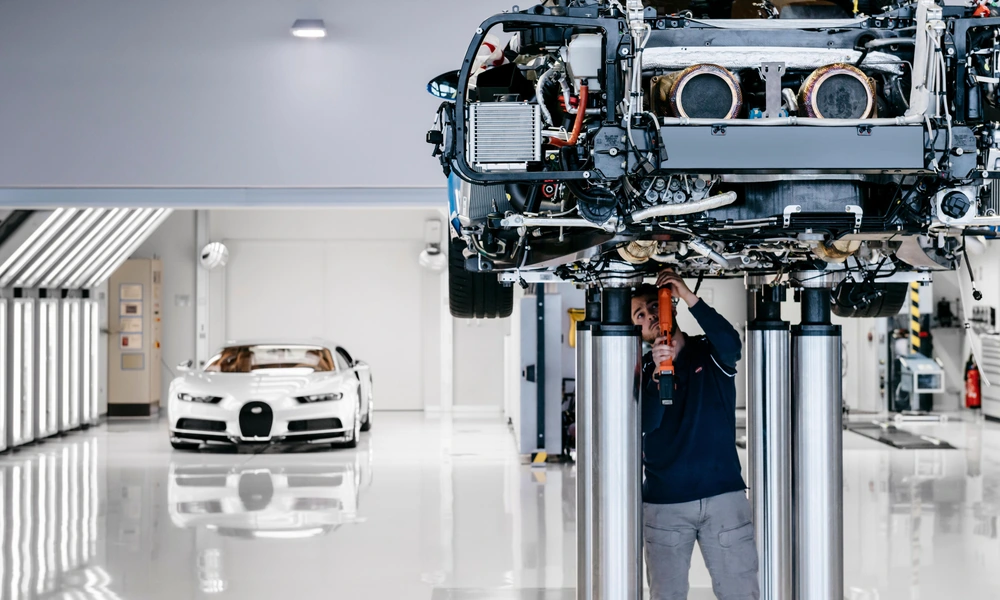
Every Bugatti is assembled in Molsheim, the same Alsatian town where Ettore started building cars in 1909. The grounds include the Château Saint Jean and the Atelier, the workshop where the modern cars take shape.
On July 2, 2026, Bugatti inaugurated La Manufacture, a new building on the Château Saint Jean grounds that was designed for the Tourbillon. It prepares and finishes bodies and interiors, which frees the older Atelier to focus on final assembly and individual customer work. Tourbillon production was scheduled to begin in September 2026.
Each car is built by skilled specialists who handle the mechanical components, bodywork, and cabin, and who check quality at every stage. By mid-2026, Bugatti said, it had delivered more than 1,100 cars since the brand’s modern revival in 2005.
Bugatti Models: A Guide to the Famous Cars
Modern Road Cars
Bugatti Veyron. The Veyron arrived in 2005 and reset expectations for what a road car could do. Its W16 produced 1,001 PS and carried the car to about 407 km/h. Later versions raised power to 1,200 PS. In total, 450 were built, in coupe and roadster forms.
Bugatti Chiron. The Chiron replaced the Veyron in 2016 with the same basic W16 layout, now delivering 1,500 PS. Later cars such as the Super Sport reached 1,600 PS. The run was capped at 500, and the last one left the factory in 2024.
Bugatti W16 Mistral. The Mistral is an open-top hypercar and the last Bugatti road car to use the W16. It makes 1,600 PS, shares much of its engineering with the Chiron Super Sport, and was limited to 99 units. In November 2024, a one-off Mistral World Record Car driven by Andy Wallace reached 453.91 km/h at the ATP test track in Papenburg, Germany, setting a new top-speed record for open-top cars.
Bugatti Tourbillon. The Tourbillon succeeds the Chiron and breaks with the W16 entirely. It pairs an 8.3-liter naturally aspirated V16, engineered with Cosworth, with three electric motors, two on the front axle and one at the rear. The petrol engine makes about 1,000 PS and the electric side about 800 PS, for a combined 1,800 PS. Bugatti claims a 0 to 100 km/h time of 2.0 seconds. Top speed is electronically limited to 380 km/h and rises to 445 km/h with a special Speed Key. The car can also travel more than 60 km on electric power alone. Production is capped at 250.
Track and Special-Edition Cars
Bugatti Bolide. The Bolide was built to be as light as possible around the W16, and it is intended for circuits, not public roads. It makes roughly 1,600 PS on pump-grade fuel and as much as about 1,850 PS on 110-octane racing fuel. Only 40 were built.
Bugatti Divo. Unveiled in 2018, the Divo is a Chiron-based car tuned for cornering. Its reworked body generates more downforce, and the 1,500 PS W16 is unchanged. Bugatti built 40, all sold before the public debut.
Bugatti Centodieci. This 2019 special honors the EB110. Its W16 was lifted to 1,600 PS, and all 10 cars have now been built and delivered.
Bugatti La Voiture Noire. A one-off shown in 2019, La Voiture Noire pays tribute to the Type 57 SC Atlantic. It wears a long, all-black body and uses the Chiron’s 1,500 PS W16.
Bugatti Brouillard. Revealed in 2025, the Brouillard is the first project from Programme Solitaire. It is a one-of-one coupe built on the Mistral, with its W16 and chassis, and it is named after Ettore Bugatti’s favorite horse.
Classic Models
- Type 35: the successful Grand Prix racer of the 1920s.
- Type 41 Royale: a giant luxury car aimed at royalty and the very rich.
- Type 57 SC Atlantic: a landmark of pre-war design.
- EB110: the 1990s revival car with a quad-turbo V12.
Each of these cars helped build the idea of Bugatti as a maker of fast, beautiful, and technically ambitious machines.
Bugatti Performance and Engine Technology
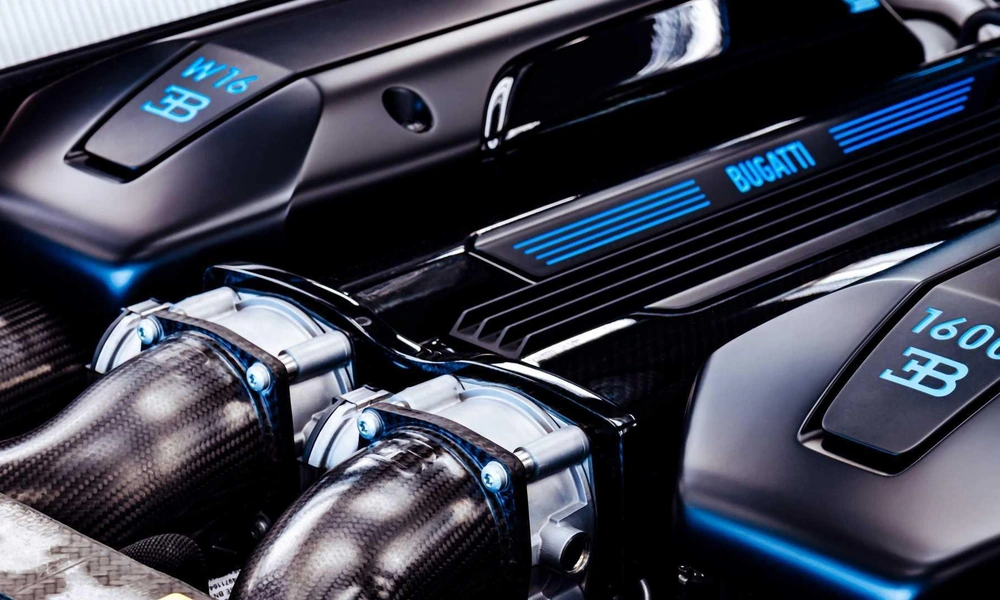
The W16
The W16 defined Bugatti from the Veyron to the Mistral. It displaces 8.0 liters, has four turbochargers, and arranges its 16 cylinders in a W shape, which keeps the engine short enough to fit in a road car. Output rose from 1,001 PS in the first Veyron to 1,200 PS in the Super Sport and then to 1,500 and 1,600 PS in the Chiron family. Such power demanded exceptional cooling, a strong transmission, and a drivetrain that could cope.
The engine also powered a series of speed records. In 2010 the Veyron Super Sport reached 431.07 km/h, and in 2013 the Veyron Grand Sport Vitesse set a roadster record of 408.84 km/h. In 2019 a modified Chiron prototype, driven by Andy Wallace at the Ehra-Lessien test track in Germany, became the first car to exceed 300 mph.
The V16 Hybrid
The Tourbillon’s engine is a new 8.3-liter V16 without turbochargers, built with help from Cosworth. It revs to a very high speed and works with the electric motors, which supply instant torque and extra power. The result is a hybrid that still puts high-revving engine character at the center.
The package is also compact for its output. Bugatti quotes a weight below 1,995 kg, which is lighter than the Veyron and Chiron, and an acceleration time of under 5.0 seconds from 0 to 200 km/h. Its battery stores about 25 kWh, enough for the electric-only range mentioned above.
Aerodynamics and Materials
At very high speeds, a car needs stability as much as power. Bugatti’s engineers work on aerodynamics, cooling, braking, suspension, and weight. Extensive carbon fiber keeps the structure stiff and light.
What Sets Bugatti Apart
- Engineering: Each model demands new solutions in engines, cooling, and aerodynamics.
- Small runs: Many cars are limited to 10, 40, 99, 250, or 500 units.
- Materials: Carbon fiber, fine leather, and machined metals feature throughout.
- Hand finishing: Specialists in Molsheim assemble and inspect every car.
- Personalization: Owners can specify colors, materials, and details.
- Research: New hypercars require years of development and testing.
Bugatti Customization and Craftsmanship
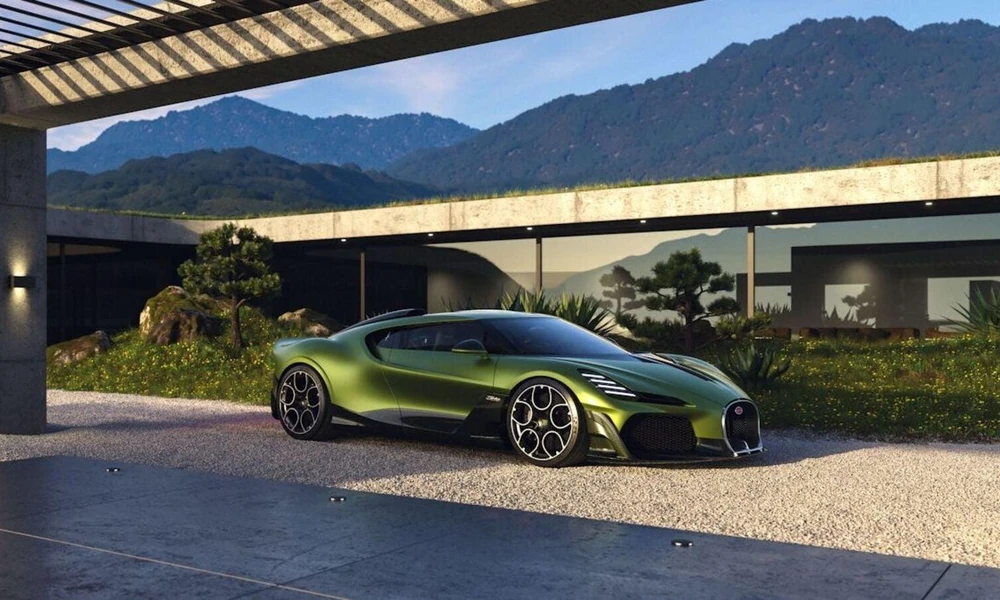
Bugatti’s Sur Mesure program, whose name means made to measure, lets owners choose exterior colors, interior materials, stitching, embroidery, and other details. Nearly every car leaves the factory with some degree of personal specification.
Programme Solitaire, introduced in 2025, goes further. It is limited to a maximum of two commissions per year, and each one is a complete one-of-one design built on an existing Bugatti powertrain and chassis, with new bodywork and interior. The Brouillard was the first. It shows how the company mixes its coachbuilding heritage with modern engineering.
Is Owning a Bugatti Worth It?
That depends on what you want from a car. Anyone who values exclusivity, extreme performance, and craftsmanship will find a Bugatti unlike an ordinary luxury car.
Ownership also asks a lot beyond the purchase itself. Specialist servicing, insurance, secure storage, and transport all need planning. Many models were built in small numbers and have ended production, so buyers may need to work through current owners or specialist dealers. A Bugatti suits someone ready for the full commitment.
Bugatti vs Other Hypercar Brands

| Brand | Main strength | Known for |
|---|---|---|
| Bugatti | Extreme speed combined with luxury | Veyron, Chiron, Tourbillon |
| Koenigsegg | Technical innovation and light weight | Jesko, Regera |
| Pagani | Artistic design and handwork | Huayra, Utopia |
| Ferrari | Racing heritage and a broad performance range | SF90, F80 |
Bugatti blends top speed with comfort. Koenigsegg is known for its technical inventiveness, while Pagani is prized for sculptural design and hand-built detail. Ferrari draws on decades of motorsport and sells a wider variety of cars. The right choice depends on what you value most.
The Future of Bugatti
The Tourbillon marks a turning point. Rather than extending the W16, Bugatti developed a V16 hybrid, and La Manufacture gives it room to build the new car. Limited production and personalization through Sur Mesure and Programme Solitaire will continue. The challenge is to keep the brand’s identity while adopting new technology.
Frequently Asked Questions About Bugatti
1. Why is the new car called Tourbillon?
The name comes from a watchmaking mechanism, and the car’s instrument display draws on watchmaking techniques. It also breaks with the Veyron, Chiron, and Divo tradition of naming models after racing drivers.
2. Can a Bugatti be customized?
Yes. Sur Mesure covers paint, materials, stitching, and other details, and Programme Solitaire creates complete one-of-one cars.
3. How many cars does Bugatti build?
It depends on the model. The Chiron was capped at 500 cars, the Mistral at 99, and the Tourbillon at 250.
4. Can a Bugatti be driven on ordinary roads?
The Veyron, Chiron, Mistral, and Tourbillon are road cars, subject to local rules. The Bolide is a track-only car.
5. Does Bugatti build its own engines?
The W16 was developed within the Volkswagen Group for the Veyron. The Tourbillon’s V16 was developed with the British specialist Cosworth.
6. Why is production so limited?
Small runs support exclusivity, hand finishing, and bespoke commissions.
7. What happens when a model ends production?
It is no longer sold new by the factory. Buyers must look to private owners or specialist dealers, and availability depends on rarity and condition.
8. Is the Tourbillon fully electric?
No. It is a plug-in hybrid that combines an 8.3-liter V16 petrol engine with three electric motors, for 1,800 PS in total.
Conclusion
Bugatti began as one man’s workshop in Molsheim and became one of the best-known names in the car world. Its story runs from the Type 35 and the Atlantic to the Veyron, the Chiron, and the rare special editions. The Tourbillon now begins a new era with V16 hybrid power. Advanced engineering, tiny production runs, and individual craftsmanship continue to set Bugatti apart.