Looking for a Leopard catamaran for sale? Leopard builds sailing catamarans and powercats in a range of sizes and layouts, and you can find both new boats and a wide choice of pre-owned models. This guide covers the current models, specifications, price examples, new and used buying options, and the checks to make before you buy.
New vs. used Leopard catamarans
Leopard catamarans are built by Robertson & Caine in South Africa, and you can buy one factory-new or second-hand through brokers and private owners. The current range has three sailing models (Leopard 43, 46 and 52) and three powercats (Leopard 40, 46 and 53). Which route suits you depends on your budget, how soon you want the boat and how much equipment you need.
Buying new
A new boat gives you the latest design, unused systems and the manufacturer’s warranty, subject to its terms. You also get a choice of cabin and equipment layouts and direct access to factory support. You can request a quote for a boat built to your specification, or look at the stock boats Leopard keeps at its service centres, which can be delivered sooner than a boat built to order.
The trade-off is cost. Before comparing offers, confirm whether the quoted price includes taxes, delivery and optional equipment.
Buying used
The second-hand market offers far more variety, including older sailing models, previous-generation boats and discontinued powercats. A used boat is usually cheaper than a comparable new one, but its condition says more than its age. Ask for maintenance records, engine hours, repair history, installed equipment and ownership details.
Some used Leopards spent years in charter fleets. That is not a reason to rule them out, but it does mean heavier use, so read the service history closely and commission an independent survey.
| Route | Main advantage | What to verify |
|---|---|---|
| Factory order | Current design and your choice of configuration | Build price and delivery time |
| New stock boat | Possibly faster delivery | Included equipment and tax status |
| Private owner | Direct access to the boat’s history | Ownership papers and service records |
| Broker | Wider selection and help with paperwork | Listing accuracy, survey and fees |
| Ex-charter boat | Often a lower asking price | Wear, maintenance and charter use |
Current Leopard models

Leopard sells two types of catamaran: sailing models that rely mainly on sails, and Powercats driven by twin engines. If you’re comparing sailing catamarans for sale, consider the differences in size, sailing performance, cabin layout and equipment.
All six boats below are in the current range. Published lengths depend on the measuring basis, so always check whether a figure includes the lifting platform or swim platforms.
Sailing catamarans
Leopard 43. Aimed at couples and smaller families, the 43 is 42 ft 7 in long with a 23 ft beam and a 4 ft 11 in draft. It comes with three or four cabins and a forward cockpit linked to the saloon, and it succeeds the Leopard 42 with a taller rig. Twin 45 hp diesels are standard, the tanks hold 158 US gallons of fuel and 174 US gallons of water, and total sail area is 1,354 sq ft.
Leopard 46. The 46 suits buyers who want more room. It replaces the Leopard 45 and measures 45 ft 7 in (47 ft 6 in with the optional lifting platform), with a 24 ft 1 in beam and a 5 ft 5 in draft. Layouts run from three to five cabins. Standard power is two 45 hp Yanmar diesels, with 57 hp engines optional, and sail area is 1,512 sq ft.
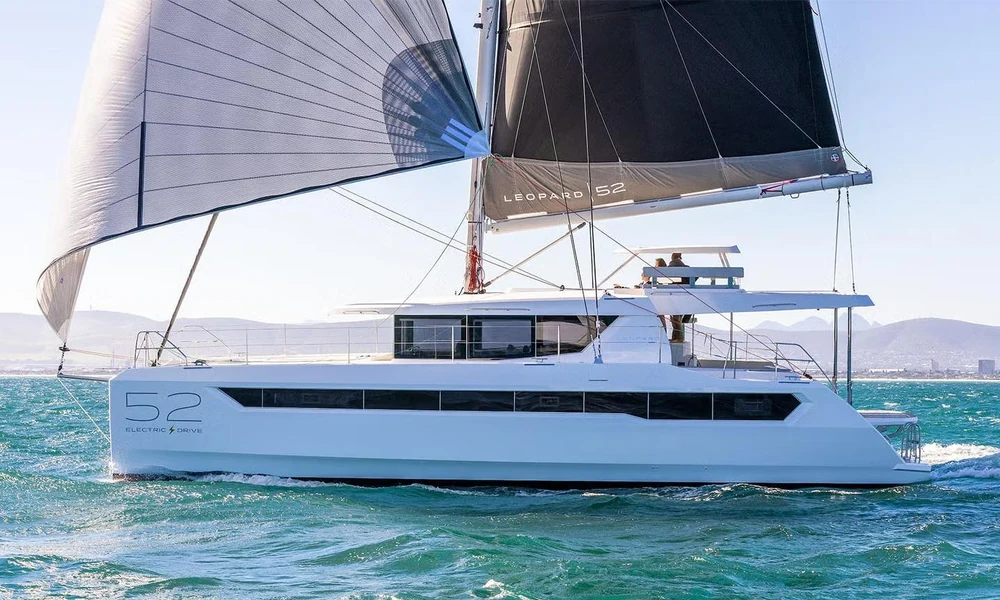
Leopard 52. The largest sailing model is 51 ft 8 in long with a 26 ft 9 in beam and 1,812 sq ft of sail, about 17% more upwind sail than the Leopard 50 it replaced. It is offered with four, five or six cabins, two 57 hp diesels as standard and an optional hybrid-electric drive. It is the natural choice for long stays aboard.
Power catamarans
Leopard 40 Powercat. At 40 ft with a 21 ft 8 in beam, it is the smallest of the three. It has three cabins and twin 250 hp diesels, with 320 or 370 hp optional.
Leopard 46 Powercat. Measuring 46 ft 4 in with a 24 ft 1 in beam, it offers three or four cabins and the same 250 hp standard engines, again with larger options.
Leopard 53 Powercat. The flagship powercat has a 25 ft 2 in beam, twin 370 hp Yanmar diesels and three or four cabins. Leopard’s pricing page gives its length as 50 ft 6 in, while independent tests quote about 53 ft 1 in, so confirm which measurement a listing uses.
Comparing the range

The tables below use Leopard’s published figures for the current range. Specifications can vary by model year and configuration.
Sailing models
| Specification | Leopard 43 | Leopard 46 | Leopard 52 |
|---|---|---|---|
| Length | 42 ft 7 in | 45 ft 7 in | 51 ft 8 in |
| Beam | 23 ft | 24 ft 1 in | 26 ft 9 in |
| Cabins | 3–4 | 3–5 | 4–6 |
| Sail area | 1,354 sq ft | 1,512 sq ft | 1,812 sq ft |
| Standard engines | 2 × 45 hp | 2 × 45 hp | 2 × 57 hp |
Power models
| Specification | 40 Powercat | 46 Powercat | 53 Powercat |
|---|---|---|---|
| Length | 40 ft | 46 ft 4 in | 50 ft 6 in* |
| Beam | 21 ft 8 in | 24 ft 1 in | 25 ft 2 in |
| Cabins | 3 | 3–4 | 3–4 |
| Standard engines | 2 × 250 hp | 2 × 250 hp | 2 × 370 hp |
*Leopard’s published figure; independent tests list about 53 ft 1 in.
Which one fits you?
- Couples: the Leopard 43 is the easiest size to handle and berth.
- Families: the Leopard 46 offers up to five cabins in a mid-size hull.
- Long stays or liveaboard use: the Leopard 52 has the most space and the widest choice of layouts.
- Engine-powered cruising: compare the 40 and 46 Powercats first.
- Maximum powercat space: the 53 Powercat is the largest.
Length alone should not decide it. Cabin layout, fuel and water capacity, handling and your intended cruising area matter just as much.
Older models on the used market
Several discontinued Leopards turn up regularly on brokerage sites, often at lower prices than current boats. The production years below are approximate market references, so check each boat’s hull identification number and build year before you rely on them.
| Model | Type | Approximate years |
|---|---|---|
| Leopard 42 | Sailing | 2020–2026 |
| Leopard 50 | Sailing | 2018–2025 |
| Leopard 45 | Sailing | 2017–2024 |
| Leopard 43 Powercat | Power | 2016–2022 |
| Leopard 58 | Sailing | 2012–2020 |
| Leopard 48 | Sailing | 2012–2019 |
| Leopard 51 Powercat | Power | 2013–2019 |
| Leopard 44 | Sailing | 2010–2016 |
| Leopard 39 | Sailing | 2010–2014 |
Model names have been reused. The Leopard 42 launched in 2020 is a different boat from the earlier Leopard 42, and the old Leopard 43 sailing catamaran is not the new 43. Always confirm the generation, not just the name.
What a Leopard costs
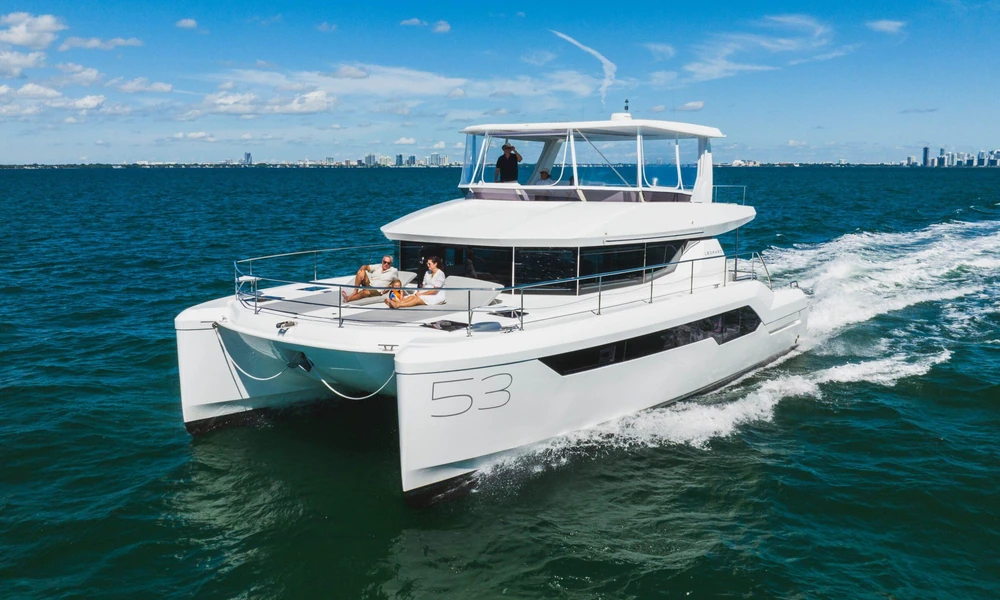
Leopard does not publish one price for each new boat. You request a quote for your chosen model and options. For a broader comparison, review catamaran prices across sailing and power models, including the factors that affect new and used boat costs.
Stock boats give a rough guide. Leopard’s European inventory has listed a 2026 Leopard 46 at €707,500, a 2026 Leopard 46 Powercat at €1,057,500, a 2026 Leopard 52 at €1,100,000 and a 2027 Leopard 43 at €580,800, all with tax unpaid. Treat these as examples, because inventory and discounts change. For comparison, a brokerage listing showed a 2026 Leopard 53 Powercat at €1,515,832. Used boats are priced one by one by their sellers, and an asking price is rarely the final price.
Several factors move the price:
- Model and year: newer, larger boats usually cost more.
- Condition: well-kept systems often beat a cheap boat that needs repairs.
- Engine hours and service history for both engines.
- Equipment: generators, watermakers, air conditioning and electronics.
- Charter history: commercial use affects interior wear.
- Location: delivery, local demand and tax status change the total.
- Documented upgrades: new rigging or recent engine work.
When comparing listings, stick to the same generation and similar build years.
Design features worth comparing

Layout. Two hulls hold the cabins, and a central saloon forms the shared living area. Cabin, bathroom and storage counts differ between boats of the same length, so compare floor plans rather than assuming they match.
Forward cockpit. Many Leopard sailing models have a forward cockpit that connects to the saloon, adding a second outdoor seating area and an easy route around the boat.
Powercat helm. Powercats use a motor-yacht-style helm and outdoor space, so compare their layouts if you prefer to cruise under engine power.
Sailing helm. On sailing models, check where the helm sits and how easily you can reach the sail controls, especially if a small crew will run the boat.
Beam. A catamaran’s width gives stability and space, but it can make marina berths harder to find and more expensive. Check berth dimensions before you commit.
Long-distance cruising
Leopard builds cruising catamarans, including models meant for extended time afloat. Whether a particular boat suits a long passage depends on its condition, equipment and preparation, and on the crew’s experience. Before planning a long trip, review:
- fuel and water capacity
- the condition of engines, sails and rigging
- navigation, communication and safety equipment
- batteries and charging systems
- weather protection and storage
- crew experience and the passage plan
A boat designed for cruising is not automatically ready for an ocean crossing. A professional inspection and careful preparation come first.
Before you buy a used Leopard
Photos and listings cannot confirm a boat’s real condition. Inspect it in person, or send someone qualified, before agreeing to a price.
- Hull and structure: look at the hulls, decks, bridge deck, rudders and fitting areas for cracks, water ingress and past repairs.
- Engines: review both engines and their cooling systems, ask for service invoices, and note the operating hours of each.
- Rig and sails (sailing models): inspect the mast, standing and running rigging, sails, winches and steering, and find out when major parts were last replaced.
- Electrics and equipment: test the batteries, chargers, electronics, generator, air conditioning and watermaker where fitted.
- History: ask whether the boat was privately owned or chartered, and request records of repairs, groundings and refits.
- Survey and sea trial: hire an independent marine surveyor and run a sea trial, which can reveal faults a dockside inspection misses.
Also request proof of ownership, registration papers, service invoices, any earlier survey reports and the VAT or other tax status. Required documents depend on the boat’s registration and where you buy.
Cost of ownership
The purchase price is only the start. A powercat’s fuel bill will differ noticeably from a sailing catamaran’s, which mainly burns fuel when motoring. Budget for the following:
| Cost | What it covers |
|---|---|
| Marina fees | Berthing, often priced by beam |
| Insurance | Vessel and liability cover |
| Engine servicing | Routine maintenance and repairs |
| Haul-out and antifouling | Lifting the boat and protecting the hulls |
| Equipment upkeep | Generator, batteries and electronics |
| Fuel | A bigger share of the budget on powercats |
| Sails and rigging | Replacement and servicing on sailing models |
| Repairs | Unplanned mechanical or structural work |
Actual figures depend on size, age, location and use. For a cross-border purchase, also check VAT, import duty, registration rules and local taxes.
Where to find one
- Leopard Catamarans: its website lists current models, stock boats and their locations.
- Leopard Brokerage: a specialist channel for pre-owned Leopards.
- Yacht marketplaces: sites such as YachtWorld let you compare years, prices and locations.
- Private sellers: you may get a fuller ownership history, but verify everything independently.
Before contacting a seller, prepare questions on build year, engine hours, tax status, previous use, maintenance records and what the price includes.
Frequently asked questions
How much does a Leopard cost?
It depends on the model, age, condition, equipment, and location. New stock boats carry advertised prices, while used boats are priced individually by their sellers.
Can I buy directly from the manufacturer?
Yes. Leopard handles enquiries for factory orders and stock boats, though availability varies by model and location.
Is the Leopard 46 the same as the Leopard 46 Powercat?
No. The first is a sailing catamaran; the second runs on twin engines and has different layouts, systems, and operating needs.
Can I live aboard full time?
Some models have layouts and facilities suited to it, but check storage, water capacity, and equipment against your needs.
Are ex-charter boats worth considering?
Yes, if they are well maintained and priced for their condition. Review the charter history, engine hours, repair records, and survey findings.
What separates the two Leopard 42 models?
They are different generations with different designs and specifications. Confirm the build year and generation rather than going by name alone.
Will it fit a standard marina berth?
Not necessarily. Catamarans are wider than most monohulls, so check the marina’s maximum width, berth availability, and extra fees.
Do I need a survey?
Yes. An independent survey and sea trial can uncover structural, mechanical, and equipment problems before you commit.
Can one person sail it alone?
Some current sailing models have helm layouts meant to help small crews, but single-handing still depends on experience, configuration, weather, and the passage.
Final thoughts
Leopard offers new sailing models, powercats and a deep pre-owned market. Settle on your use, cabin needs, budget and propulsion first. Then compare specifications, study maintenance and ownership records, and arrange a survey. For a new boat, confirm current inventory, equipment, pricing and tax with Leopard or an authorised dealer.