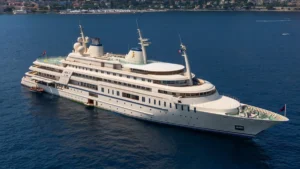
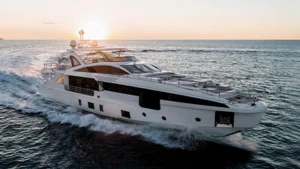
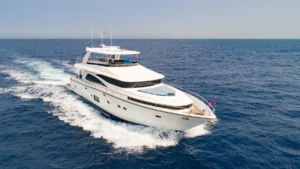
A 500-foot yacht is about 152.4 metres long, which places it among the largest private vessels afloat. A ship of this size can hold multiple decks, large guest suites, pools, entertainment spaces, crew quarters and complex marine systems, although the exact facilities change from one design to the next.
Several real superyachts sit close to this length. Al Said (155 m) and Dilbar (156 m) were both built by the German yard Lürssen, which also delivered the 160-metre Blue in 2022.
A yacht this big is far more than a luxury toy. It needs advanced engineering, a professional crew, steady maintenance and careful voyage planning, and its costs depend heavily on design, equipment and use. This guide covers dimensions, real examples, interiors, construction, expenses and the practical side of ownership.
How Big Is a 500-Foot Yacht?

Five hundred feet equals 152.4 metres. Yacht length is normally quoted as length overall (LOA), measured from the front of the hull to the back.
| Unit | Value |
|---|---|
| Feet | 500 ft |
| Metres | 152.4 m |
| Inches | 6,000 in |
| Yards | 166.67 yd |
| Kilometres | 0.1524 km |
Length tells only part of the story. Other measurements matter just as much:
- Beam: the widest point of the hull.
- Draft: the depth from the waterline to the lowest part of the hull.
- Displacement: the weight of water the yacht pushes aside, which equals its weight at that moment.
- Gross tonnage (GT): a measure of enclosed internal volume, not weight.
Gross tonnage is especially useful for comparing large yachts. Two vessels of similar length can hold very different amounts of interior space because their width, height and deck layout differ. A 500-foot yacht is five times as long as a 100-foot one, but its usable space does not scale in such a simple way. Comparing it with a 150-foot yacht also shows how beam, draft and gross tonnage affect interior space.
Are There Any 500-Foot Yachts in the World?
Yes, although none is exactly 500 feet. Several yachts fall just above that mark and show what this size class looks like in practice.
| Yacht | Length | Length in feet | Builder | Delivered |
|---|---|---|---|---|
| Al Said | 155 m | 508.5 ft | Lürssen | 2008 |
| Dilbar | 156 m | 511.8 ft | Lürssen | 2016 |
| Blue | 160 m | 524.9 ft | Lürssen | 2022 |
These are selected examples, not a complete ranking of large yachts.
Al Said was delivered in 2008 and is one of the closest well-known matches to 500 feet. Published specifications give it 15,850 GT, a beam of about 24 metres, a steel hull and an aluminium superstructure. Listings quote room for up to 70 guests and 174 crew. Its most unusual space is a concert hall reported to seat a 50-piece orchestra.
Dilbar measures 156 metres, or roughly 511.8 feet, and was delivered in 2016. Its 25-metre swimming pool holds about 180 cubic metres of water and is widely described as the largest ever fitted to a yacht. At 15,917 GT, it also shows how interior volume can outgrow what length alone suggests.
Blue is a 160-metre yacht delivered in 2022. It uses a diesel-electric hybrid propulsion concept, exhaust treatment and a modern wastewater system, which shows that megayacht engineering now goes beyond conventional diesel power.
Inside a 500-Foot Yacht: Interior and Luxury Features
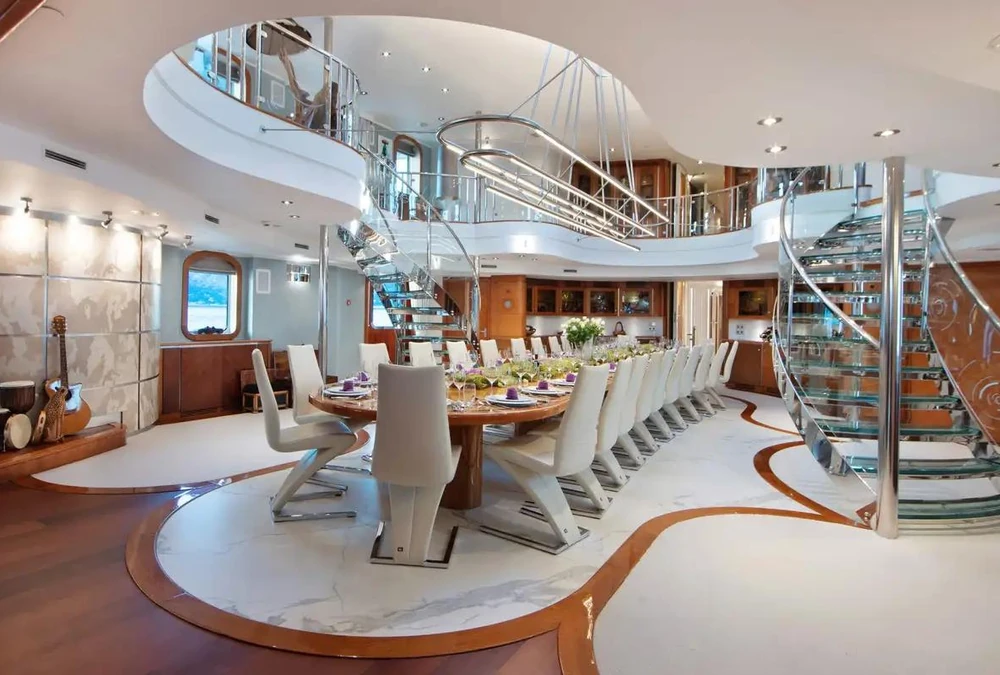
A vessel this size can devote several decks to cabins, dining, entertainment and service areas. The final layout reflects the owner’s wishes and the naval architect’s plan.
Accommodation. Guest areas can include large suites with bathrooms, dressing rooms and sitting areas. The owner’s apartment may take up a generous private section, while crew live separately, with their own cabins, mess rooms and work spaces.
Wellness. Depending on the design, a yacht may offer indoor and outdoor pools, spas, treatment rooms, gyms, saunas, steam rooms and jacuzzis. Dilbar’s pool is a real illustration of the scale involved.
Entertainment. Possible spaces include cinemas, music rooms, large dining halls, lounges, bars and open-air entertainment decks. Al Said’s concert hall is a rare, memorable example.
Helicopters and toys. Some megayachts have helicopter landing pads, and a few have hangars. Tender garages hold the small boats that ferry guests ashore, and other storage can hold jet skis, diving gear and even a submarine.
Outdoor decks. Sun decks, alfresco dining areas, swimming platforms, shaded seating and beach clubs give guests space near the water.
No 500-foot yacht has every one of these features. What it carries depends on its layout and intended use.
How Much Does a 500-Foot Yacht Cost?

There is no reliable universal price for a yacht of exactly 500 feet. Contracts for custom superyachts are private, and published figures are often estimates rather than confirmed transactions.
The main cost drivers are:
| Cost factor | What it covers |
|---|---|
| Hull construction | Steel structure and main vessel build |
| Naval architecture | Hull design, stability and engineering |
| Propulsion | Engines, propellers and related systems |
| Electrical systems | Generators and power distribution |
| Interior design | Suites, furniture and finishing |
| Navigation equipment | Radar, communications and bridge systems |
| Luxury facilities | Pools, spas, cinemas and other amenities |
| Testing and delivery | Sea trials, inspections and commissioning |
The shipyard, designers and degree of customization can change the final bill dramatically. Buyers interested in custom yachts should also consider how bespoke layouts, materials, engineering and onboard equipment affect the construction budget. A yacht built around lavish entertainment spaces and advanced propulsion has very different requirements from a simpler one.
Can you buy one? These vessels are usually built to order. Some existing megayachts reach the brokerage market, but availability is thin and many large yachts are never publicly listed. A buyer must also budget for crew, maintenance, insurance, fuel and suitable berths.
How Much Does It Cost to Maintain a 500-Foot Yacht?
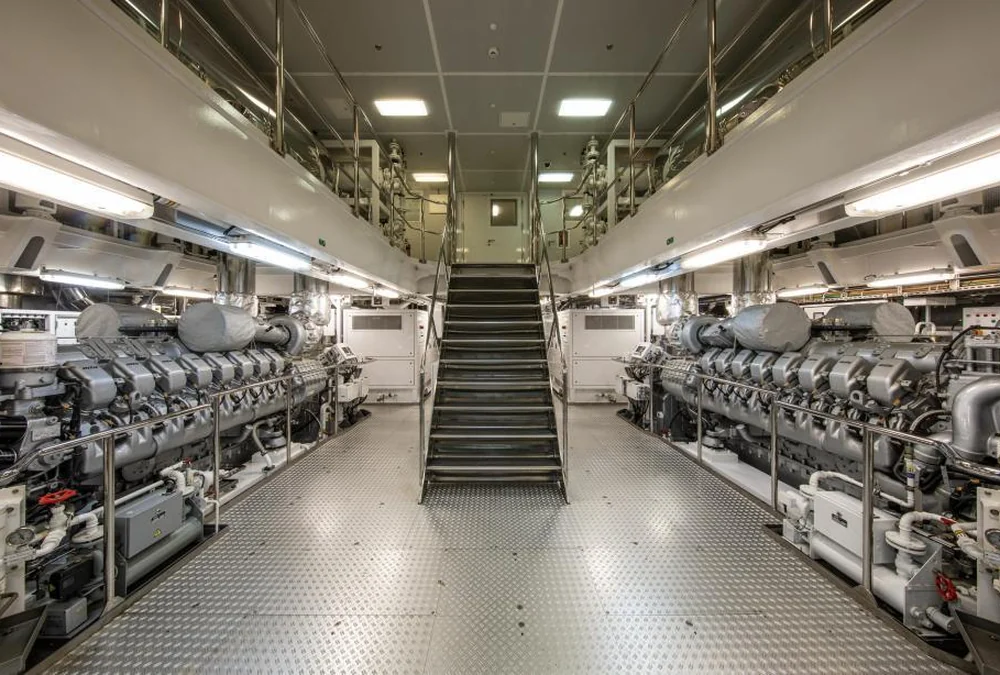
The purchase price is only the start. Running a vessel this large means continuous spending on people, machinery, fuel and upkeep, and the total depends on how often the yacht sails, how many people it employs and how much maintenance it needs.
Crew. A professional crew operates the vessel safely and looks after guests. Departments typically include the captain and deck officers, engineers, deck crew, chefs, housekeeping and interior staff, and sometimes security or specialists. Al Said’s published crew figure of 174 shows how large the payroll can become.
Fuel. Fuel feeds the engines and the generators. Consumption depends on engine power, cruising speed, distance, time underway, displacement and sea conditions. Higher speeds demand much more power, so fuel costs cannot be worked out from length alone.
Maintenance and repairs. Engines, hulls, paintwork, electrical equipment and navigation systems all need regular attention. Large refits can involve interiors, technical systems and exterior surfaces.
Insurance and berthing. Premiums depend on vessel value, cruising areas, usage and coverage. Berthing can be difficult too, because few marinas can take a yacht about 152 metres long, and some locations require special arrangements for anchoring and shore services.
| Expense | Main factors |
|---|---|
| Crew | Salaries, employment and training |
| Fuel | Speed, distance and engine use |
| Maintenance | Machinery, hull and equipment |
| Insurance | Value, location and coverage |
| Berthing | Marina and port availability |
| Refits | Repairs and major upgrades |
| Supplies | Food, water and onboard services |
No verified annual figure fits every 500-foot yacht. A realistic budget needs the actual vessel’s operating data and a detailed cost assessment.
How Many People Can a 500-Foot Yacht Accommodate?
Capacity depends on design and on how the vessel is operated. It helps to separate three groups:
- Guests: people staying onboard for private use.
- Crew: employees who operate and maintain the yacht.
- Passengers: people carried under the applicable legal arrangements.
Al Said again offers a useful example, with published specifications listing up to 70 guests and 174 crew. Those numbers belong to that one vessel and should not be applied to every 500-foot yacht.
A bigger yacht does not automatically carry more passengers commercially. The permitted number depends on the vessel’s certification, flag state, design and the regulations that apply.
How Does a 500-Foot Yacht Work?

Several connected systems move the vessel, generate power and support everyone onboard.
Propulsion. Large motor yachts usually rely on marine diesel engines, with shafts, propellers, gearboxes, steering gear and manoeuvring thrusters. Some newer yachts, such as Blue, use diesel-electric or hybrid arrangements.
Electrical power. Generators and distribution systems supply air conditioning, refrigeration, kitchens, water systems, entertainment, navigation and communications.
Navigation and communication. The bridge is the control centre, where the captain and officers use radar, GPS, electronic charts and monitoring displays. Satellite communication keeps the yacht connected far from shore.
Stabilization and safety. Stabilizers improve comfort, while bilge pumps, fire detection and firefighting equipment, emergency power and lifesaving appliances protect those onboard. The exact systems depend on the design and certification.
How Are 500-Foot Yachts Built?

Building one is a major engineering project involving naval architects, marine engineers, designers, shipyard workers and specialist suppliers. The process generally runs through these stages:
- Planning: the owner defines the purpose, style and facilities.
- Naval architecture: engineers develop the hull, dimensions and stability plans.
- Design development: designers shape the exterior and interior layouts.
- Hull construction: the yard builds the main structure.
- Machinery installation: engines, generators and propulsion go in.
- Electrical installation: wiring, power systems and controls are fitted.
- Interior outfitting: cabins, dining rooms and entertainment spaces are completed.
- Testing: engineers check equipment and systems.
- Sea trials: the yacht is tested on the water before delivery.
There is no fixed timeline. A custom project can take several years, depending on engineering demands, design changes, equipment installation, interior work, shipyard capacity and supplier availability.
What Materials Are Used?
Material choices affect strength, weight, durability and performance. Steel is the usual choice for the hulls of very large yachts because of its structural strength, while aluminium often forms the superstructure to keep weight down above the waterline. Al Said follows exactly this pattern, according to published specifications.
Other materials include marine-grade glass, composites in suitable places, stainless steel, teak and other interior woods, and stone or other decorative finishes. The final mix depends on the engineering design and intended use.
Rules and Safety Requirements
A yacht of this size must meet maritime safety and environmental requirements, which vary with its flag, use, construction date, passenger numbers and operating area. Key areas include registration, safety equipment, fire protection, lifesaving appliances, navigation and communication, crew qualifications, pollution prevention, and surveys and certification.
Two international conventions matter most:
- SOLAS sets international standards for ship safety, covering construction, equipment and operation. How it applies depends on the vessel and circumstances.
- MARPOL deals with pollution from ships, including oil, sewage, garbage and air emissions.
Commercial yachts may also have to follow a yacht code. The Red Ensign Group Yacht Code Part A, for example, applies to yachts of at least 24 metres in load line length that are in commercial use, carry no more than 12 passengers and were built from 1 January 2019. Yachts carrying more than 12 passengers fall outside Part A and are assessed under other requirements.
These are not universal rules for every private yacht, so the flag-state and international requirements must be checked for each vessel.
Challenges of Owning a 500-Foot Yacht
- Finding ports: few marinas can take a 152-metre vessel, so length, beam and draft shape every route.
- Managing a large crew: accommodation, training and employment arrangements need proper oversight, with the captain and senior officers coordinating navigation, engineering and guest service.
- Planning maintenance: many technical systems need regular inspection, and careful scheduling reduces breakdowns and downtime.
- Security and privacy: owners may need access controls, onboard security staff and discreet travel planning.
- International travel: port entry rules, customs, immigration, registration and local maritime regulations all need attention.
These demands are why professional yacht management is so important.
Environmental Impact
A 500-foot yacht uses large amounts of resources. Its footprint depends on engines, fuel, operating schedule and waste systems.
Big engines burn fuel for propulsion, and generators burn more to power onboard systems. Emissions vary with design, speed and conditions. The yacht also needs systems to treat sewage, wastewater and solid waste, and MARPOL sets the international framework, though the precise rules depend on classification and operation.
Newer technology can help: diesel-electric hybrid propulsion, better exhaust treatment, efficient generators, smart energy management and wastewater treatment. Blue combines several of these. Even so, hybrid propulsion does not make a large yacht emission-free.
500-Foot Yacht vs. Other Large Yachts
A 500-foot yacht belongs to a different size league from nearly all private pleasure craft. For comparison, a 300-foot yacht is considerably shorter but can still offer extensive guest accommodation, entertainment facilities and long-distance cruising capabilities.
| Length | Metres | Typical description |
|---|---|---|
| 100 ft | 30.48 m | Large yacht |
| 150 ft | 45.72 m | Superyacht |
| 200 ft | 60.96 m | Large superyacht |
| 300 ft | 91.44 m | Megayacht |
| 400 ft | 121.92 m | Very large megayacht |
| 500 ft | 152.4 m | Very large megayacht |
These are informal labels, not official international categories.
Is it bigger than a cruise ship? It is longer than many small passenger vessels, but large cruise ships are considerably longer and carry far more people. Cruise ships exist for commercial passenger transport, while superyachts focus on private accommodation and individual ownership.
Frequently Asked Questions
Is a 500-foot yacht exactly 152 metres?
It is 152.4 metres. The figure of 152 is a rounded conversion.
What is the closest existing yacht to 500 feet?
Among the examples here, Al Said is closest at 155 metres, or about 508.5 feet.
Can a 500-foot yacht cross the Atlantic?
It can be designed for ocean voyages, but real range depends on fuel capacity, engine efficiency, speed, weather and supplies.
Will it fit in a normal marina?
Not necessarily. It needs a berth with enough space, water depth and supporting facilities.
Does it need more than one captain?
One master is responsible for the vessel, but several senior deck officers can share navigation and watchkeeping.
Can it have a private hospital?
A yacht can include a medical room or dedicated medical facilities, but a fully equipped hospital is not standard.
Is gross tonnage the same as weight?
No. Gross tonnage measures enclosed volume through a standard calculation, not the yacht’s actual weight.
Why can two 500-foot yachts have very different prices?
Materials, engineering, propulsion, interiors, equipment and customization all differ, so similar length does not mean similar build requirements.
Conclusion
A 500-foot yacht is roughly 152.4 metres long and sits at the top end of the private superyacht world. Vessels such as Al Said, Dilbar and Blue show what is possible at this scale through advanced engineering, large accommodation and specialist facilities.
Length is only one part of the picture. Gross tonnage, beam, draft, propulsion, guest capacity and operating needs matter just as much when comparing large vessels. The cost of building and maintaining one depends on its design, equipment, crew and intended use, and understanding those factors shows what separates these giants from conventional luxury boats.