
For decades, the automotive world has accepted a fundamental law of physics: you can have extreme performance, or you can have four seats, but you cannot have both in the same shell. If you wanted to go 250 mph, you had to squeeze into a cockpit designed for two people and maybe a toothbrush. If you wanted to take your family on a road trip, you had to settle for a heavy SUV or a high-performance sedan that, while fast, could never be called a “hypercar.”
In 2026, that law has been officially repealed. The Koenigsegg Gemera 2026 has arrived in its final production form, and it is unlike anything the world has ever seen. At turboocruiser.com, we have spent years tracking the development of this “Mega-GT,” and after putting it through its paces, we can confidently say that Christian von Koenigsegg has once again moved the goalposts for the entire industry.
This is not just a fast car with extra chairs. This is a 2,300-horsepower engineering miracle that redefines what a family hypercar can be.
The Heart of the Beast: Two Flavors of Insanity
The most significant update for the 2026 model year is the finalization of the powertrain options. When the Gemera was first revealed as a concept, it was powered by a revolutionary three-cylinder engine. However, as production drew closer, Koenigsegg realized they could fit something even more ambitious into the frame.
The “Tiny Friendly Giant” (TFG)
The base version of the Gemera utilizes the TFG, a 2.0-liter, three-cylinder, twin-turbo engine. Now, in any other car, a three-cylinder would be a budget option. Here, it is a masterpiece. Using Freevalve technology (which replaces traditional camshafts with independent actuators), this tiny engine produces 600 horsepower on its own.
When paired with the new “Dark Matter” electric motor, the TFG Gemera delivers a combined 1,400 horsepower. This version is lighter and more nimble, appealing to those who appreciate the sheer technical wizardry of getting that much power out of such a small displacement.
The HV8: The Most Powerful 4-Seat Car in Existence
For those who believe that there is no replacement for displacement, Koenigsegg shocked the world by announcing the HV8 (Hot V8) option. By utilizing the Light Speed Transmission (LST) technology from the Jesko, engineers managed to fit a full 5.0-liter twin-turbo V8 into the Gemera without sacrificing a single inch of cabin space.
The numbers for the HV8 are simply difficult to comprehend:
Horsepower: 2,300 hp (on E85 fuel)
Torque: 2,750 Nm
0–60 mph: 1.9 seconds
Top Speed: Over 250 mph
This configuration makes the Gemera the most powerful 4-seat car ever to hit the streets. It is a vehicle that can out-accelerate a Formula 1 car while your three passengers watch a movie on the rear infotainment screens.
Engineering the Impossible: The Dark Matter Motor and LSTT
To achieve 2,300 horsepower in a car that needs to be comfortable for a grocery run, Koenigsegg had to invent entirely new components. You won’t find these parts in a Ferrari, a Lamborghini, or even a Bugatti.
The Dark Matter Electric Motor
In previous hybrids, you often needed multiple electric motors to get serious power. Koenigsegg’s new “Dark Matter” motor is a “Raxial Flux” unit—a patent-pending blend of radial and axial flux technology. It produces 800 hp and 1,250 Nm of torque by itself. The best part? It only weighs 39 kilograms. It is so small that it fits into spaces where other manufacturers put a water pump.
The Light Speed Tourbillon Transmission (LSTT)
A traditional dual-clutch transmission is heavy and complex. The LSTT in the Gemera is a 9-speed, multi-clutch system that removes the need for a flywheel. This allows the engine to rev with a level of responsiveness that feels like a racing motorcycle. It can jump from 9th gear to 3rd gear instantly, without having to cycle through the gears in between. This is what allows the Gemera to provide that “telepathic” power delivery that reviewers are raving about in 2026.
Design and Aerodynamics: A Silhouette Like No Other
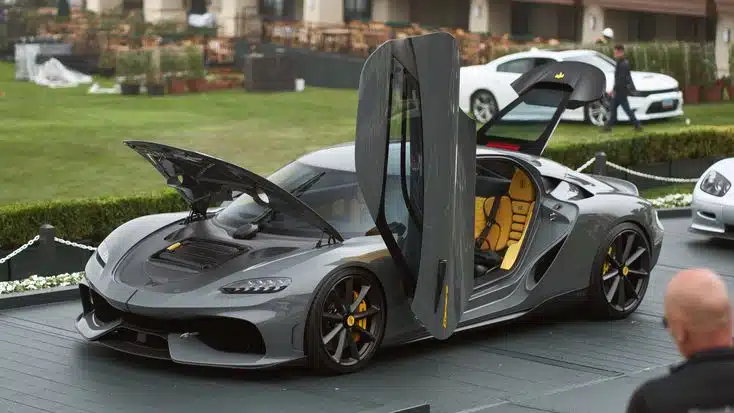
From the outside, the Gemera looks like a stretched Jesko, but every line serves a purpose. The most striking feature is the lack of a “B-pillar”—the vertical support usually found between the front and rear doors.
The KATSAD Doors
The Gemera uses Koenigsegg’s signature “Automated Twisted Synchrohelix Actuation Doors.” Because there is no B-pillar, these doors are massive. They sweep up and forward, revealing the entire side of the interior. This means the front passengers don’t even have to move or tilt their seats to let the rear passengers in. It is, quite literally, the most elegant way to enter a car ever designed.
Aerodynamic Efficiency
Despite being a large four-seater, the Gemera is incredibly slippery. The air is guided through massive side intakes to cool the mid-mounted engine, while the “venturi tunnels” at the rear generate enough downforce to keep the car glued to the road at 200 mph. It manages to look graceful and aggressive at the same time, avoiding the “bloated” look that many four-door performance cars suffer from.

The Interior: Living the “Mega-GT” Lifestyle
This is where the Gemera truly earns its title as the ultimate family hypercar. Stepping inside feels more like entering a private jet than a supercar.
Space for Real Humans
Many cars claim to be “2+2” (two seats for adults, two for children). The Gemera is a true four-seater. Because the engine is tucked far back and the electric motor is so compact, there is enough legroom for four adults over six feet tall to sit comfortably. You could drive from Monaco to St. Moritz with four people, and no one would feel cramped.
Technology and Comfort
The cabin is a tech-lover’s dream. In 2026, the Gemera comes standard with:
Dual Infotainment: 13-inch screens in both the front and the rear.
Connectivity: Apple CarPlay, wireless charging for all four passengers, and high-speed Wi-Fi.
The Cup Holders: This has become a legendary Koenigsegg trivia point. There are eight cup holders—four heated and four cooled. Even in a hypercar, Koenigsegg understands that your coffee should stay hot and your water should stay cold.
Sound System: A 11-speaker bespoke audio system that uses the car’s carbon fiber frame to amplify bass, creating an immersive experience that rivals a home theater.
Practicality: The 250-mph Daily Driver?
One of the most frequent questions we get at turboocruiser.com is: “Can you actually use this car?” Most hypercars spend their lives in climate-controlled garages because they are too difficult to drive on real roads. The Gemera is designed to be the exception.
Luggage Capacity
If you are taking a trip, you need bags. Koenigsegg designed the Gemera so that four full-sized carry-on suitcases can fit in the car—three in the rear trunk and one in the front. This is unheard of in the hypercar world.
All-Wheel Drive and Steering
To handle 2,300 horsepower, you need more than just good tires. The Gemera features a sophisticated All-Wheel Drive system with torque vectoring. This means the car can send power to whichever wheel has the most grip at any millisecond. Furthermore, it features four-wheel steering, which makes this long car feel as nimble as a Miata in tight city corners.
Ground Clearance
The Gemera is equipped with a front and rear hydraulic lift system. In 2026, we know that speed bumps and steep driveways are the natural enemies of carbon fiber. With a push of a button, the Gemera rises high enough to clear most urban obstacles, making it a viable car for a night out in the city.
Pricing and Exclusivity: The Koenigsegg Gemera Price
Ownership of a Gemera is a privilege reserved for the ultra-elite. While the Koenigsegg Gemera price initially started around $1.7 million for the three-cylinder version, the introduction of the HV8 option has pushed the average transaction price much higher.
TFG Version: ~$1.7 Million
HV8 Upgrade: +$400,000
Full Customization: Most owners spend an additional $200,000–$500,000 on bespoke paint, interior materials, and “naked” carbon fiber finishes.
With only 300 units being produced, the demand has far outstripped the supply. By the time the first production units hit the road in 2026, the car was already sold out. For those looking to buy one now, you will likely have to navigate the secondary market where prices are already reaching $3 million to $4 million for a build slot.
The Verdict: A Masterpiece for the Ages
The Koenigsegg Gemera 2026 review conclusion is one of genuine awe. It is rare that a car lives up to five years of hype, but the Gemera has exceeded it. It is a vehicle of contradictions: it is silent yet deafening, massive yet agile, and terrifyingly fast yet incredibly safe.
Christian von Koenigsegg set out to build a car that his family could enjoy together, and in doing so, he built a car that changed the rules of the game. For the lucky 300 owners, they aren’t just buying a car; they are buying a piece of history.
If you want the world’s most powerful 4-seat car, the most advanced hybrid system ever conceived, and a interior that rivals a luxury lounge, the Gemera is in a class of one.
Stay tuned to turboocruiser.com for more exclusive first drives and technical deep dives into the world of high-end performance.
Frequently Asked Questions (FAQs)
How many Koenigsegg Gemeras will be made?
Koenigsegg has limited production to exactly 300 units. This ensures that the car remains an incredibly rare collectible while allowing the company to maintain strict quality control over each hand-built machine.
What is the range of the Gemera?
The Gemera is a plug-in hybrid. It can travel approximately 30 miles (50 km) on pure electric power for silent city driving. When the gas engine and the 75-liter fuel tank are fully utilized, the total range is estimated at around 600 miles (1,000 km), making it a true Grand Tourer.
Is the V8 version faster than the 3-cylinder?
In a straight line, yes. The HV8 has a significantly higher top speed and more mid-range punch. However, the 3-cylinder TFG is lighter in the nose, which some test drivers say makes it feel more “playful” on twisty mountain roads.
What kind of fuel does it use?
Like all modern Koenigseggs, the Gemera is designed to run on E85 (ethanol) to achieve its maximum power figures. However, it can also run on standard high-octane gasoline or even CO2-neutral “Vulcanol” (methanol) if you want to be as environmentally friendly as possible.