

The ultimate fast EV sedan 2026 battle is unique because it is an intensive, high-stakes internal family feud. The Audi RS e-tron GT and the Porsche Taycan Turbo S share the exact same engineering DNA—developed collectively on the high-voltage Volkswagen Group J1 performance platform.
Yet, despite sharing an identical 800-volt foundation, these two hyper-sedans handle the open road with completely distinct personalities. Porsche aims for surgical track precision, while Audi focuses heavily on continent-crushing grand touring comfort.
With both models receiving massive structural, thermal, and electronic updates for the 2026 model year, the taycan vs etron gt rivalry has reached an absolute boiling point. Let’s look at which high-performance machine truly deserves your hard-earned capital.
The Mechanical Twins: Same Bones, Different Tuning
Underneath their aggressive, low-slung body panels, both cars employ a permanent dual-motor synchronous electric powertrain layout. They utilize a highly innovative 2-speed automatic transmission bolted directly to the rear axle. This distinct gearbox allows for explosive launches in first gear while shifting seamlessly to a longer second gear to maximize highway cruising efficiency.
The differences lie in how much raw power each brand unlocks from the software parameters of this platform.
The 2026 Audi RS e-tron GT Performance steps up its game significantly, delivering a massive peak output of 912 horsepower during temporary launch control boosts.
The Porsche Taycan Turbo S pushes the thermal management limits of the hardware even harder, cranking out a staggering 938 horsepower under temporary overboost. This gives the stallion from Stuttgart a slight raw numbers advantage when hunting for the ultimate title of best electric performance sedan.
Straight-Line Violence: Launch Control Reality
Stepping on the throttle of either vehicle results in immediate, neck-snapping acceleration that challenges the limits of human perception.
The Porsche Taycan Turbo S relies on its slightly higher torque output and aggressive power delivery curve to rocket from 0 to 60 mph in an astonishing, track-verified 2.3 seconds.
The Audi RS e-tron GT Performance is right on its heels, flashing from 0 to 60 mph in a blinding 2.4 seconds. While Porsche offers an even crazier track-special Turbo GT trim that flirts with the 2.1-second mark, the street-level battle between the Turbo S and the RS e-tron GT remains virtually deadlocked in real-world scenarios.
Ride Character: Grand Tourer vs. Track Weapon
The real divergence in this audi rs etron gt vs porsche taycan turbo s 2026 comparison comes down to chassis dynamics and daily suspension tuning philosophies.
Audi outfits the RS e-tron GT with a highly compliant, intelligent adaptive air suspension system utilizing 2-chamber, 2-valve air shocks. It actively rounds off sharp road imperfections, keeping the cabin calm, quiet, and perfectly insulated during high-speed highway cruising. It handles long road trips effortlessly without beating up the driver.
Porsche utilizes its highly advanced, optional Active Ride Control suspension system. This hydraulic setup works tirelessly to keep the heavy chassis completely flat through tight corners, eliminating body roll entirely by pushing down against cornering forces. The steering feedback in the Taycan feels sharper, heavier, and more connected, establishing it as the clear choice for drivers who want genuine sports-car agility in a heavy, four-door electric wrapper.
Thermal Management and Real-World Range
High-performance EVs face a massive hurdle: managing heat during sustained aggressive driving or rapid charging. For 2026, both manufacturers have revised their battery chemistry, expanding the usable capacity up to a gross 105 kWh battery pack.
Audi has optimized its predictive navigation route planner to pre-condition the battery cell temperatures perfectly before you arrive at a station. This ensures the pack doesn’t overheat, allowing the car to sustain high charging speeds for longer periods.
Porsche introduces a revised regenerative braking system that can recapture an impressive amount of energy under deceleration without overtaxing the battery’s thermal ceiling. This brings the real-world driving range of both vehicles to a highly usable 275 to 300 miles under normal operating conditions.
Performance and Charging Specification Guide
| Technical Specifications | 2026 Audi RS e-tron GT Performance | 2026 Porsche Taycan Turbo S |
| Base Starting Price | Approx. $171,795 | Approx. $221,400 |
| Peak Horsepower (Boost) | 912 hp | 938 hp |
| Sustained Horsepower | 730 hp | 764 hp |
| 0-60 mph Sprint Time | 2.4 seconds | 2.3 seconds |
| Max DC Charging Speed | 320 kW | 320 kW |
| 10% to 80% Charge Time | Approx. 18 minutes | Approx. 18 minutes |
| EPA Estimated Range | 278 miles | 275 miles |
Interior Layout, Comfort, and Everyday Usability
Inside the cockpit, the design languages separate the tech-focused minimalist from the classic luxury operator.
Audi keeps a highly functional interior layout by retaining a dedicated row of physical climate control buttons directly beneath the main touch screen. It features the beautiful Audi Virtual Cockpit plus on a crisp 12.3-inch HD display. The materials feel premium, incorporating optional Serpentine Green or Express Red stitching alongside a lightweight matte carbon roof that lowers the car’s physical center of gravity.
Porsche favors an ultra-minimalist, completely screen-heavy environment. It shifts almost all physical climate vents and vehicle dynamics adjustments into capacitive touch panels with haptic feedback. While the Taycan’s sweeping screen array looks incredibly futuristic, it requires a bit more active menu-diving while on the move, which can be polarizing for traditional drivers.
Design and Aerodynamics
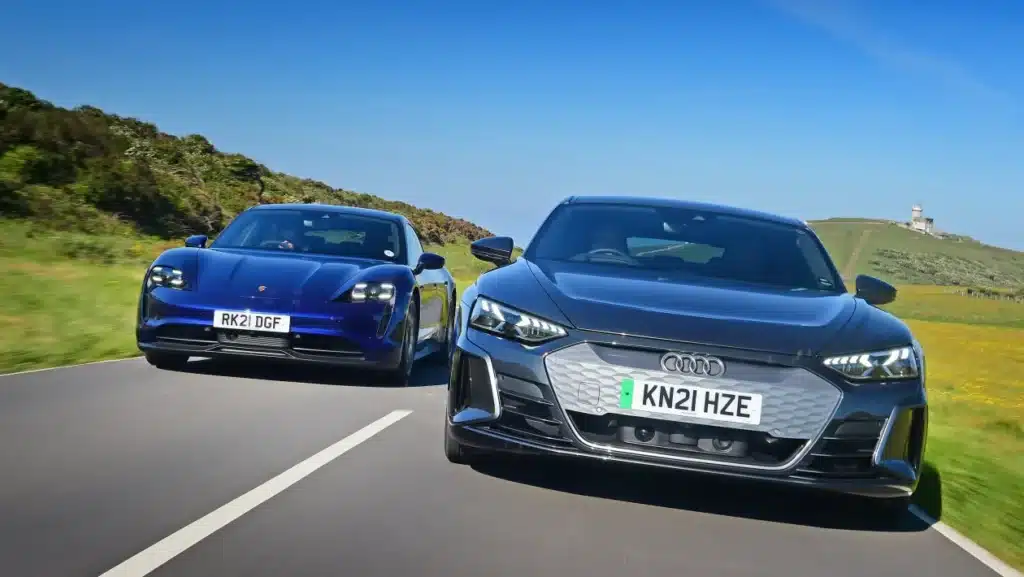
The exterior architecture of these vehicles shows how minor styling changes yield completely different visual weight. The Audi RS e-tron GT features wide, muscular rear haunches and a deeply sculpted hood line that makes it look incredibly wide and mean from the rear view. It retains an elegant, swept-back roofline that screams classic grand touring proportions.
The Porsche Taycan Turbo S focuses heavily on active track aerodynamics. It features vertical air curtains directly beneath the iconic four-point LED headlights to guide air smoothly around the front wheels. A massive, multi-stage adaptive rear spoiler adjusts its angle dynamically depending on vehicle speed and drive mode, maximizing downforce when cornering or minimizing drag to eke out extra range on long highway drives.
Financial Considerations: The Cost of the Badge
When navigating the upper tiers of luxury electric vehicles, the financial delta between these two cars becomes impossible to ignore. Because they share identical structural underpinnings, buying the Porsche means paying a massive brand premium.
The Taycan offers an endless, highly customizable options catalog where paint-to-sample finishes, bespoke leather shades, and specialized carbon accents can easily push the final invoice past the $250,000 mark. Audi chooses a streamlined approach, bundling their highest-tier engineering into packaged trim lines, making it significantly easier to order and maintain a predictable price ceiling.
Conclusion: The Financial and Functional Verdict
The ultimate winner of this high-voltage electric performance war depends entirely on your personal driving lifestyle, aesthetic preference, and budget parameters.
The Audi RS e-tron GT Performance emerges as the smarter financial play for the vast majority of luxury buyers. Starting at roughly $171,795, it delivers virtually identical 0-60 acceleration, equivalent 320 kW ultra-fast charging speeds, and a significantly more cushioned, isolated daily ride for roughly $50,000 less than its corporate cousin. It is the definitive daily driver grand tourer.
The Porsche Taycan Turbo S remains the ultimate statement piece for uncompromising driving purists. If you demand absolute flat-cornering dynamics, maximum brand prestige, and a highly customized build tailored specifically to your taste, the Turbo S completely justifies its premium price tag the second you hit a technical mountain pass.
Frequently Asked Questions (FAQ)
Which car charges faster at a public station?
It is a complete draw. Both vehicles utilize the upgraded 800-volt J1 platform architecture, allowing them to pull a maximum rate of 320 kW at a compatible DC fast-charging station. Both can replenish their battery packs from 10% to 80% in roughly 18 minutes.
Does the Porsche Taycan or Audi e-tron GT offer more storage space?
The Audi e-tron GT sedan offers a standard 405-liter rear trunk. The Porsche Taycan Turbo S sedan drops down to 366 liters due to its packaging. However, Porsche wins overall cargo versatility because they offer the Taycan in practical Sport Turismo and Cross Turismo wagon body styles.
Can you drive these performance EVs using just one pedal?
No. Unlike many commuter EVs, both Audi and Porsche intentionally avoid heavy, aggressive one-pedal regenerative braking calibrations. Both engineering teams prefer a traditional, natural coasting and brake-pedal feel to preserve classic sports-car driving dynamics.
What is the real-world driving range for these models in 2026?
Thanks to extensive battery chemistry upgrades for the 2026 model year, both high-performance vehicles feature real-world highway ranges hovering reliably around 275 to 280 miles per charge, depending on your wheel size choices and ambient climate.
Why is the Audi significantly cheaper if they share the same platform?
Porsche positions itself as an elite, ultra-exclusive sports car brand, allowing them to command a much higher luxury price premium. Audi offers fewer complex custom individual options, passing those manufacturing efficiencies directly down to the buyer as substantial savings.