
The asphalt of the Green Hell is slick with tension this season. The battle for the ultimate nurburgring lap record 2026 has escalated into a mechanical cold war. Automotive engineering boundaries are being utterly shattered by relentless factory development teams.
Manufacturers are no longer fighting over simple fractions of a second in Germany. Instead, they deploy extreme aerodynamics and hybrid powertrains to claim the fastest nurburgring lap. Every single turn represents a dangerous gamble against physics.
The legendary Eifel mountains host this ongoing battle for global supremacy. Testing cars here requires immense driver courage and flawless computational planning. The crown of the fastest brand changes hands with every passing week.
The Outright King: Mercedes-AMG ONE
When discussing the ultimate road-legal lap record hypercar, the Mercedes-AMG ONE remains the benchmark. This incredible machine brings genuine Formula 1 technology directly to public streets. It adapts elite tier racing hardware for the world’s most unforgiving toll road.
Driven by racing driver Maro Engel, the AMG ONE delivered a mind-bending time of 6:29.090. This historic run utilized a highly complex 1.6-liter V6 turbocharged hybrid engine setup. The powertrain works alongside four electric motors to generate a combined 1,063 horsepower.

To secure this incredible nurburgring record car title, the vehicle relies heavily on active aerodynamics. The front diffusers and rear wing constantly adjust to balance downforce with low straight-line drag. It remains the absolute pinnacle of street-legal performance on the track today.
The engineers spent years refining the complex cooling systems for this powertrain. Managing thermal loads during a full flying lap is incredibly difficult for hybrid engines. Yet, this vehicle proved that racing technology can survive the brutal bumps of the Nordschleife. This historic run utilized a highly complex 1.6-liter V6 turbocharged hybrid engine setup. This kind of Formula 1-derived hybrid tech is becoming standard across the segment, as seen in our review of the Koenigsegg Gemera 4-seater hypercar, which uses a similarly radical powertrain philosophy.
The Track-Only Weapon: Ford GT Mk IV
The absolute biggest shock of the ring record 2026 season came from the United States. Ford Performance sent shockwaves through the industry with their track-only masterpiece. The vehicle dumps all standard road-legal constraints to focus entirely on pure racing physics.
On April 1, 2026, factory driver Frédéric Vervisch piloted the extreme Ford GT Mk IV. He clocked a spectacular 6:15.977 around the full Nordschleife circuit. This achievement crowns it as the fastest pure internal combustion engine machine in track history.
The vehicle achieves this incredible speed through an aggressively elongated carbon fiber body. This long-tail configuration stabilizes the chassis when flying over the crests at Antoniusbuche. The engineering focus was purely on maximizing high-speed ground effects.
Power comes from a unique twin-turbocharged EcoBoost V6 engine pushing past 800 horsepower. This motor couples with an uncompromised racing gearbox for instantaneous gear changes. Multimatic adaptive spool valve suspension manages the changing track elevations perfectly.
Only 67 examples of this vehicle will ever be produced globally. This limited production run marks the grand finale for this legendary supercar generation. It serves as a beautifully loud celebration of historic American endurance racing victories.
American Muscle Evolution: Ford Mustang GTD Competition
The hypercar class isn’t the only segment rewriting the history books this year. Ford struck a second massive blow with their production-intent supercar killer. This vehicle was built specifically to hunt down elite European exotics on their home turf.
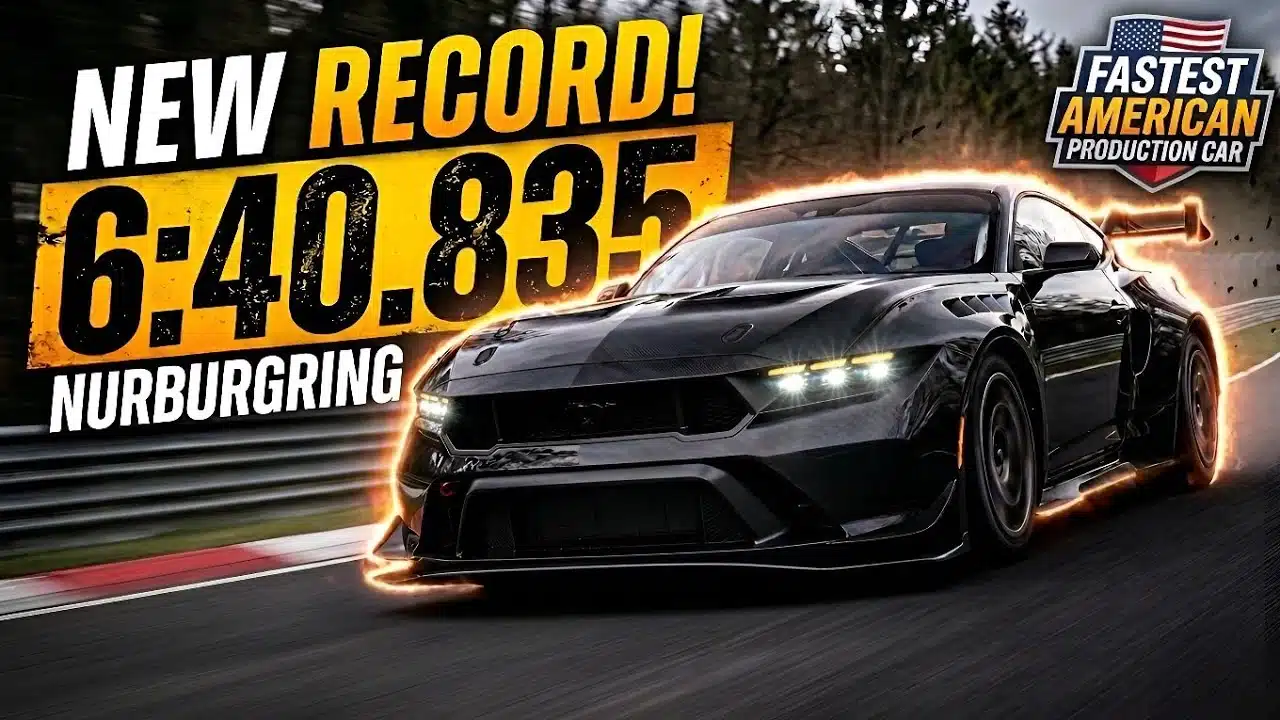
The ultra-exclusive Mustang GTD Competition clocked an official time of 6:40.835. Driven by Dirk Müller, this run shattered the previous record by a staggering eleven seconds. It cements the vehicle as an absolute force within the production car world.
The vehicle achieves this pace through aggressive weight reduction and raw mechanical grip. It integrates lightweight magnesium wheels, carbon bucket seats, and active Drag Reduction System wing modifications. The supercharged 5.2-liter V8 engine pushes well past 815 horsepower to dominate the asphalt.
Engineers placed the transmission in the rear to create a perfect weight balance. This layout allows the driver to apply power much earlier when exiting tight corners. The aggressive front dive planes keep the nose pinned down through the dangerous Fuchsröhre section.
The Precision Machine: Porsche 911 GT3 RS Manthey Kit
Porsche refuses to sit idly by while American manufacturers claim track supremacy. The legendary Weissach brand deployed the updated 911 GT3 RS fitted with a specialized Manthey Kit. This track package refines an already potent weapon into an absolute surgical tool.
Driven by brand ambassador Jörg Bergmeister, the modified coupe stopped the clocks at 6:45.389. This incredible nordschleife record run relied on a naturally aspirated 4.0-liter flat-six engine. The motor produces 525 horsepower, proving that raw power is not everything.

The Manthey engineering upgrades generate over a metric ton of downforce at high velocities. A prominent carbon fiber rear wing integrates an F1-style central stabilizing fin. This design prevents the car from breaking traction through high-speed corners like Mutkurve.
The package introduces an advanced semi-active suspension system built for this specific chassis. Drivers can adjust compression and rebound settings directly from the steering wheel. This allows immediate adjustments to match changing track surface conditions in real time. This incredible nordschleife record run relied on a naturally aspirated 4.0-liter flat-six engine. For a broader look at how this platform stacks up against rivals, check out our comparison of Porsche 911 GT3 RS vs Ferrari 296 GTB for the ultimate track-day showdown.
The Autonomous Revolution: Xiaomi YU7 GT Track Package
Technology took a wild leap forward during recent test sessions in Germany. The first officially timed autonomous record lap was successfully completed on the circuit. This milestone has forced track management to create an entirely new timing classification.
The fully autonomous Xiaomi YU7 GT completed the full circuit in 10:29.483 minutes. There was no human driver sitting inside the vehicle to handle the steering wheel. Onboard artificial intelligence managed all acceleration, braking, and cornering tasks seamlessly.
The vehicle utilized an advanced end-to-end software architecture to read the track layout. It interpreted seventy-three distinct corners and three hundred meters of elevation change effortlessly. The computer calculated grip levels dynamically to avoid spinning out on the curbs.
This run proves that machine learning can handle extreme performance environments safely. The system uses a dedicated vehicle dynamics model to predict chassis sliding before it happens. This achievement marks the dawn of a new era for autonomous engineering development.
The Electric Frontier: Emerging Tech Challenges
The push for absolute dominance has forced a massive technological split in the industry. High-voltage platforms are generating unbelievable acceleration numbers out of low-speed corners. However, electric powertrains face a brutal, physics-based enemy on the Nordschleife: excessive curb weight.
Vehicles like the Chinese Yangwang U9 Xtreme utilize massive quad-motor platforms for power. Hauling heavy lithium battery packs through tight, off-camber corners creates immense stress on the tires. Therefore, engineering teams are focusing heavily on developing advanced torque vectoring software systems.

These computers adjust power to individual wheels thousands of times per second to help. They actively force heavy chassis through high-speed bends without destroying the rubber compound. Managing thermal energy over a long distance remains the greatest challenge for electric vehicles.
Battery packs tend to overheat when subjected to continuous full-throttle deployment. When temperatures spike, the onboard systems trigger a protective power restriction mode. Overcoming this thermal barrier requires revolutionary cooling geometry and solid-state chemistry. Our deep dive into next-gen EV batteries and what to expect in 2026 explains exactly how solid-state tech could solve this exact overheating problem.
Historical Context: How the Green Hell Has Evolved
The layout of this legendary German racing circuit has changed significantly since 1927. Originally built to showcase German automotive engineering excellence, it remains the ultimate testing destination. The track winding through the Eifel forest features unmatched surface complexity.
In the early decades, the circuit lacked modern safety barriers and asphalt smoothness. Drivers risked their lives hitting massive bumps surrounded by heavy target trees. Legendary racer Jackie Stewart famously coined the terrifying nickname used by enthusiasts today.
Modern track safety initiatives have added extensive catch fencing and gravel trap zones. Despite these vital updates, the fundamental challenge of the topography remains completely unchanged. The track still tests the structural rigidity of every modern hypercar chassis.
The official timing methods have also shifted to ensure global competitive fairness. The official timing methods have also shifted to ensure global competitive fairness. Full track specifications, safety regulations, and official records are maintained directly on the Nürburgring official website, which serves as the authoritative source for circuit information. Independent notaries must now verify vehicle weights and production component compliance before runs. This strict verification process prevents manufacturers from using illegal racing slicks or prototype fuels.
Aerodynamics and Tire Grip Physics
Conquering the Nordschleife requires a delicate balance between mechanical grip and aerodynamic downforce. At speeds exceeding two hundred miles per hour, air becomes a heavy physical barrier. Hypercars must carve through this air while using it to press the tires down.
Modern active aerodynamic systems use hydraulic actuators to change wing angles instantly. On the long Döttinger Höhe straightaway, the wings flatten to reduce drag forces. When entering heavy braking zones, they tilt upward to act as massive air brakes.
Tire technology has evolved concurrently to handle these incredible aerodynamic loads. Manufacturers collaborate directly with brands like Michelin to create custom rubber compounds. These specialized tires must survive intense friction without blistering over the twelve-mile lap.
If a tire compound is too soft, it will disintegrate before reaching the final sector. If the compound is too hard, the car will slide off the damp track surfaces. Achieving the perfect balance is a highly guarded secret among tire technicians.
Inside the Manufacturer Pit Lane Logistics
An official lap record attempt looks less like a casual track day and more like a military operation. Teams arrive at the circuit with massive support trailers filled with diagnostic computers. Engineers monitor dozens of live telemetry channels from the pit wall.
Mechanics use specialized thermal blankets to preheat tire sets to optimal operating temperatures. Portable weather stations track wind direction and track surface moisture across various sectors. A sudden microclimate rain shower in the forest can ruin months of planning.

Drivers spend hours analyzing video footage alongside data engineers to find fractions of a second. They study throttle application percentages and corner entry angles meticulously. Every single bump on the track must be memorized to prevent unsettling the vehicle chassis.
Key Performance Standings: Campaign Leaderboard
The performance metrics below highlight the elite times recorded during recent official track campaigns. These verified benchmarks demonstrate how different drivetrain concepts tackle the exact same ribbon of asphalt.
Porsche 919 Hybrid Evo: 5:19.546 | Twin-Turbo V4 Hybrid | Outright Racing Prototype
Ford GT Mk IV: 6:15.977 | Twin-Turbo V6 | Track Only Production Run
Xiaomi SU7 Ultra Prototype: 6:22.091 | Triple-Motor Electric | Pre-Production Prototype
Mercedes-AMG ONE: 6:29.090 | 1.6L F1 Hybrid V6 | Street Legal Production Tier
Ford Mustang GTD Competition: 6:40.835 | Supercharged 5.2L V8 | Production Track Package
Porsche 911 GT3 RS Manthey Kit: 6:45.389 | Naturally Aspirated 4.0L | Production Street Legal
Conclusion
The ongoing battle for the fastest lap time proves that the automotive industry is thriving. Whether utilizing pure combustion power, complex hybrid setups, or electric platforms, the destination remains identical. Engineers will continue to sacrifice sleep to shave seconds off their times.
The Green Hell continues to be the ultimate judge of automotive engineering truth. No simulator can perfectly replicate the bumps, compression zones, and changing weather of this track. As the season progresses, expect more teams to launch aggressive record attempts.
Frequently Asked Questions
What is the difference between the 20,600m and 20,832m Nürburgring lap measurements?
Historically, older lap times omitted a short 232-meter straightaway section near the T13 grandstand structure. However, since 2019, the track management group officially mandates a full, continuous 20,832-meter lap for certified records. This change adds roughly 4 to 5 seconds to modern times compared to historic runs.
Why do manufacturers use track-only cars to break records?
Track-only models allow engineers to completely ignore restrictive road-legal safety and emission regulations. They can drop the ride height incredibly low, run aggressive slick tires, and deploy extreme wings. These modifications would be completely illegal on public streets.
How do active aerodynamics help a car lap the track faster?
Active aerodynamics utilize motorized wings and flaps controlled by onboard computers. On long straights, the wings flatten out to reduce drag and maximize top speed. When entering hard braking zones and corners, the wings tilt upward to push the tires into the pavement for maximum grip.
Can electric hypercars maintain peak power for a full Nordschleife lap?
It is incredibly difficult due to intense heat buildup. A full hot lap demands sustained maximum energy draw for over six minutes straight. This load can cause batteries to overheat and enter a protective “limp mode.” Advanced cooling architecture is required to survive the run.
Who oversees and verifies these official lap times?
Official record attempts are strictly coordinated directly with the Nürburgring track management team. The runs are timed using precise transponder systems. Furthermore, independent notaries certify the vehicle’s production specifications and weight to ensure complete competitive fairness.