
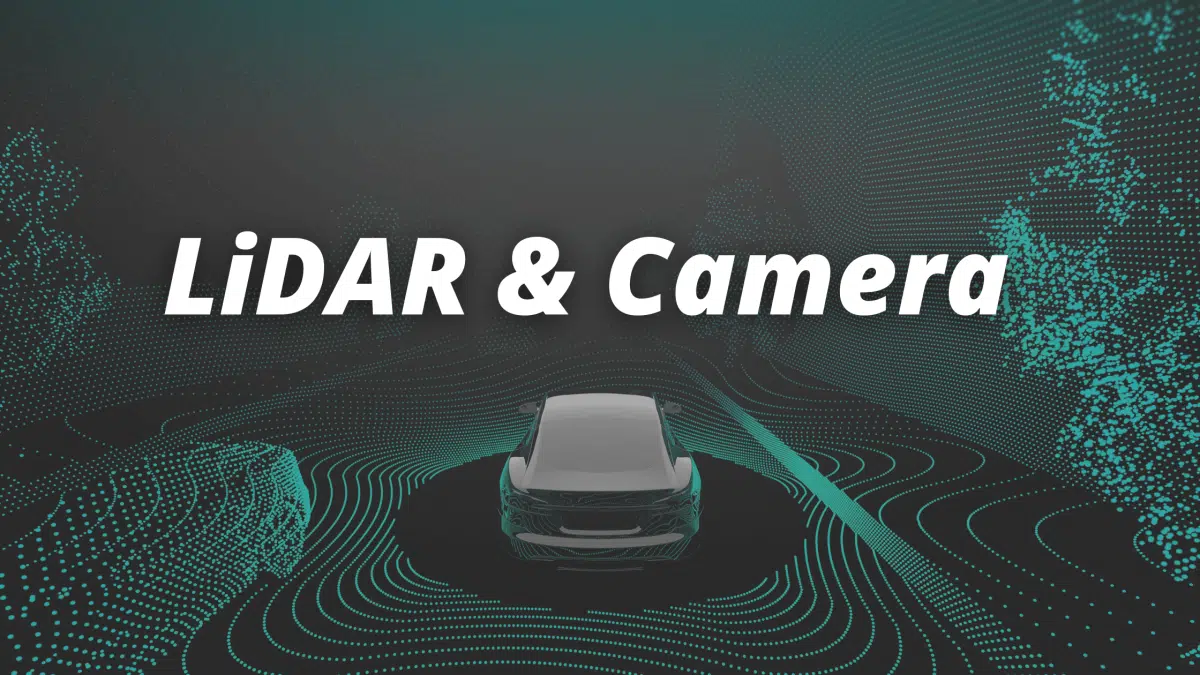
The race for autonomous driving has split the automotive world right down the middle. If you look at the self-driving cars hitting the roads, you will notice two completely different design philosophies. On one side, companies like Mercedes-Benz, Volvo, and Waymo pack their vehicles with laser-based sensors. On the other side, Tesla completely relies on cameras and artificial intelligence.
The industry is divided because automakers are balancing two massive priorities: guaranteed safety redundancy and manufacturing costs. Proponents of laser tracking want flawless depth perception in any weather. Meanwhile, the camera camp believes advanced AI can replicate how human eyes process the world for a fraction of the cost.
Understanding this split requires analyzing how these sensors work, the financial costs of production, and how these choices affect real-world driving. This breakdown explores the lidar vs camera self driving debate to see which technology serves as the best self driving sensor setup in the modern market.
What Is LiDAR and How Does It Work?
LiDAR stands for Light Detection and Ranging. This hardware functions as an active system by emitting millions of invisible laser pulses per second into the surrounding environment. By measuring exactly how long it takes for each laser beam to bounce off an object and return, the configuration calculates precise distances.
This rapid firing creates a dense, highly detailed three-dimensional structural map of the environment known as a point cloud. When comparing lidar vs camera setups, this point cloud tells the onboard computer the precise shape, size, and distance of every object within centimeters.
The primary advantage of this hardware is its independence from ambient lighting. It functions flawlessly in pitch darkness, blinding sunlight, or when entering a dark tunnel. It measures raw physical boundaries rather than interpreting visual data, making it a critical component for autonomous car sensors 2026 configurations.
What Is Camera-Only (Vision-Only) Technology?
he camera, only method, often called Vision-Only, replaces laser hardware with a suite of optical lenses distributed around the vehicle body. This configuration captures raw visual data from a full 360-degree field of view to power the vehicle.
Because standard video lacks native depth information, this approach relies heavily on neural networks and deep-learning AI models. The software processes two-dimensional images and estimates depth by analyzing pixel movement, object sizes, and relative perspective.
This configuration mimics human biology. Humans navigate roads using two eyes combined with neural processing, without shooting lasers from our foreheads. This architecture relies entirely on the processing power of the artificial intelligence brain behind the glass lenses, representing the core philosophy behind the tesla vision vs lidar debate.
The Core Debate: Lidar vs Camera
The core industry conflict centers on a fundamental disagreement regarding safety margins and data management.
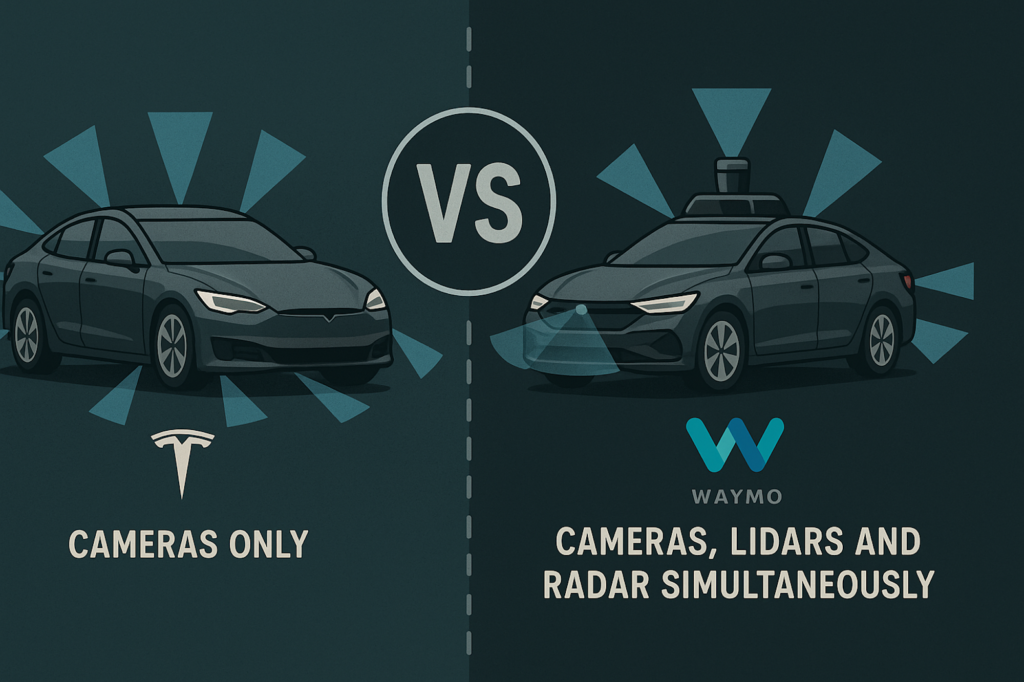
Automakers backing laser technology treat it as an essential safety layer. A standard camera can misinterpret a geometric shadow or a faded lane marking on the asphalt. A laser scanner ignores color variations and reads the physical contours of the road, meaning it cannot be fooled by visual illusions. This makes many engineers believe that lasers are required for premium safety suites.
Conversely, the vision camp argues that laser hardware acts as an unnecessary crutch that creates a data bottleneck. Laser sensors generate massive point clouds that demand immense onboard computing power to process. Furthermore, lasers cannot read traffic signs, detect color changes on a traffic light, or interpret written text. Because an autonomous vehicle must use cameras for these tasks anyway, vision advocates believe it is more efficient to train the AI to handle depth perception through the lenses as well.
Tesla Vision vs LiDAR: Two Opposing Philosophies
The most prominent example of this industry split is tesla vision vs lidar.
Tesla removed all radar units and ultrasonic sensors from its production lines, transitioning entirely to an eight-camera system called Tesla Vision. This software architecture utilizes structural transformers and spatial neural networks to build a three-dimensional vector space from two-dimensional video feeds.
Tesla leverages a massive data scale advantage. Millions of customer vehicles drive on public roads daily, collecting real-world driving data that continuously trains Tesla’s neural networks via over-the-air updates. This direct rejection of traditional autonomous car sensors 2026 setups has created a massive divide in automotive manufacturing.
Most competitive automotive brands reject this single-sensor approach. Companies like Waymo use multi-sensor fusion, combining several laser modules with multiple cameras and radar units. While Tesla builds its system around algorithmic scalability and cost reduction, the broader industry prioritizes strict sensory redundancy to ensure there is no single point of failure when evaluating lidar vs camera applications.
Comprehensive Comparison: Lidar vs Camera-Only Systems
| Feature / Metric | LiDAR-Based Multi-Sensor Systems | Camera-Only (Vision-Only) Systems |
| Primary Data Type | Active 3D geometric point clouds | Passive 2D video frames |
| Distance Measurement | Direct, highly accurate calculations | Algorithmic depth estimation |
| Performance in Darkness | Flawless operation | Dependent on headlight illumination |
| Adverse Weather Capability | Degrades in thick fog and heavy rain | Prone to lens blockage and glare |
| Color & Sign Recognition | Completely incapable | Highly proficient |
| Hardware Manufacturing Cost | Estimated $500 to $1,500 per vehicle | Estimated $50 to $150 for full camera array |
| Onboard Computing Load | Extremely high data processing demand | High, specialized AI processing demand |
| Current Autonomy Level | Achieved Level 3 commercial deployment | Remains Supervised Level 2 functionality |
| Target Market Use | Featured on the premium lidar cars list | Standard across all production vehicles |

Why Automakers Are Divided
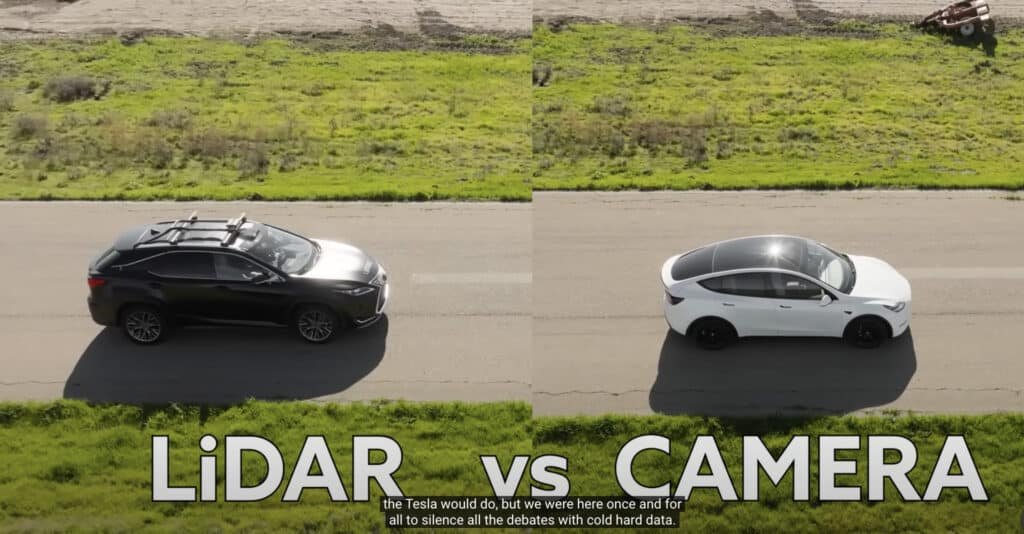
The divergence in engineering choices comes down to a clear trade-off between manufacturing economics and regulatory validation when choosing the best self-driving sensor package.
1. Production Costs and Scalability
The financial burden of hardware is a critical consideration for mass-market manufacturing. A full automotive laser array adds hundreds or thousands of dollars to production costs, which directly increases the retail price for consumers. Camera lenses are inexpensive commodity components. Choosing a vision-only strategy allows a manufacturer to deploy autonomous software features across an entire fleet of affordable consumer cars without raising vehicle base prices, tilting the economics of lidar vs camera deployment.
2. Achieving True Level 3 Autonomy
The Society of Automotive Engineers defines Level 3 autonomy as conditional driving automation where the person behind the wheel can legally divert their attention from the road. To grant this certification, regulatory bodies demand rigorous hardware redundancy from automated platforms.
If an optical camera is blinded by a direct blast of morning sunlight or covered by mud, a vision-only vehicle loses its primary data feed. A laser system provides an independent back-up layer that allows the vehicle to safely navigate to a stop, making it easier for models on the lidar cars list to secure regulatory approval for eyes-off operation.
The Best Self-Driving Sensor Mix
When evaluating the best self-driving sensor package, industry consensus favors a combined approach rather than an exclusive choice.
True safety comes from sensor fusion, where the unique strengths of one hardware type cover the vulnerabilities of another. Cameras provide crucial color data, texture detail, and context like reading construction signs. Lasers contribute absolute spatial distance metrics and night-vision capabilities. Radar provides long-range velocity tracking and operates effectively through heavy fog.
Relying on a single sensor type leaves a system vulnerable to edge cases. Combining these distinct data streams creates a reliable perception engine capable of handling complex urban traffic safely, showing that the ultimate answer to lidar vs camera self driving is often to use both.
Vehicles on the Market: The Lidar Cars List
Many premium manufacturers include laser hardware directly on their production models to power advanced driver assistance systems (autonomous car sensors 2026). The following lidar cars list highlights several models utilizing this technology:
Mercedes-Benz S-Class & EQS: Equipped with front-facing laser modules to support the Drive Pilot system, allowing legal hands-free and eyes-off highway driving under specific conditions.
Volvo EX90: Features a standard roof-integrated laser sensor developed by Luminar, designed to spot low-contrast obstacles hundreds of meters ahead.
BMW 7 Series: Utilizes laser integration inside the front grille to power its Level 3 personal copilot functionalities in select international markets.
Lucid Air: Incorporates a high-resolution laser module as part of its DreamDrive Pro driver assistance package.
Lotus Eletre: Uses deployable laser pods that emerge from the bodywork to maintain clean aerodynamics when the automated driving system is inactive.
This growing lidar cars list demonstrates that premium brands favor hardware redundancy over software-only estimation.
The Path Forward for Autonomous Tech
The division between laser integration and vision-only systems will likely persist for several years as both approaches mature.
Solid-state laser technology is advancing rapidly, replacing older mechanical spinning parts with micro-mirror arrays. This shift improves durability and lowers production costs closer to consumer-friendly levels, disrupting the balance of industry arguments. Concurrently, the rapid evolution of vision-language models and AI processing chips is closing the depth-perception gap for camera systems.
The ultimate winner of this technology split will be determined by real-world safety data and production economics. If vision-only neural networks can prove they match human safety levels across millions of miles, mass-market manufacturing will lean toward cameras. However, if regulators mandate physical redundancy to eliminate safety risks, laser integration will become standard equipment on the assembly line.
For deep-dive reviews of the latest vehicles, automotive technology breakthroughs, and detailed breakdowns of modern driver assistance systems, explore the expert insights at Turboocruiser.
Frequently Asked Questions (FAQs)
Why does Tesla avoid using LiDAR sensors in its vehicles?
Tesla avoids using these sensors primarily because of high manufacturing costs and software design choices. The company believes that adding extra hardware layers complicates data processing, and that advanced vision-based artificial intelligence can safely navigate roads using optical cameras alone.
Can LiDAR see and read traffic signs?
No, laser sensors cannot read traffic signs or detect colors. They only measure physical shape, contour, and distance. When evaluating a setup, autonomous vehicles must use optical cameras alongside lasers to read road signs and identify traffic light signals.
Does rain or thick fog disrupt LiDAR performance?
Yes, heavy rain, dense fog, and airborne dust can scatter laser light beams, which reduces the overall accuracy and range of the sensor. However, it still provides valuable structural tracking when combined with traditional radar systems and cameras to form a reliable array in poor weather.
Are camera-only autonomous cars legal?
Yes, camera-only systems are legal and widely available as Level 2 driver-assistance features, which require the driver to keep their hands on the wheel and remain attentive. Securing higher-level approval for driverless operation without secondary backup hardware remains a major regulatory challenge.
Which sensor technology is safer for autonomous driving?
Systems that combine lasers, cameras, and radar are generally considered safer because they provide data redundancy. If one sensor is blinded by bad weather or poor lighting, the other sensors continue tracking obstacles to prevent accidents.